Skip to content
Google Cloud handbook · PDF ebook · 2026 service names

Learn Google Cloud end to end, one service at a time.

18 parts through IAM, GKE, Cloud Run, BigQuery, Pub/Sub, networking, security, AI, DevOps and FinOps. 63 service chapters built on the same 12-part template, with gcloud commands, billing, pitfalls and interview notes, plus 5 reference architectures.

18
parts
90
chapters
63
service deep-dives
5
reference architectures
₹149₹39963% off
  • Secure checkout via Razorpay
  • Digital PDF ebook
  • Read on phone, tablet or laptop
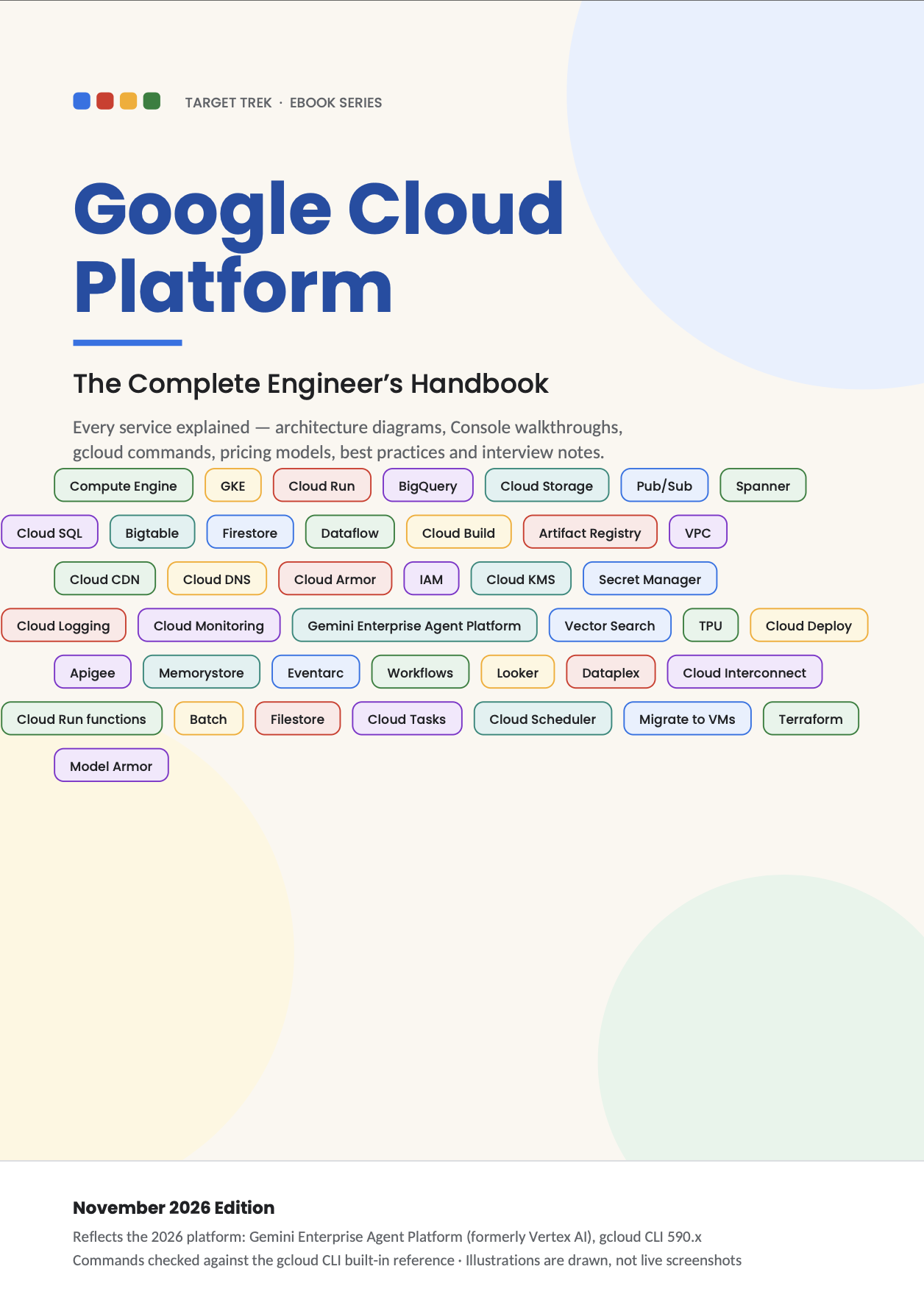
Google Cloud Platform ebook coverPDF ebook
In short

What is Google Cloud (GCP) Engineer's Handbook?

The Google Cloud (GCP) Engineer's Handbook is an 18-part PDF ebook by Target Trek that teaches the whole Google Cloud platform: how Google Cloud is built, identity and governance, compute, containers, serverless, storage, databases, data and analytics, networking, security, AI, DevOps, observability, FinOps, APIs and migration. Every service chapter follows the same 12-part structure, and the book ends with five reference architectures, certification guidance, interview questions and a gcloud cheat sheet. It uses the 2026 service names, such as Gemini Enterprise Agent Platform (formerly Vertex AI).

Inside the PDF

  • 18 parts, from how Google Cloud is built to certifications
  • Every service chapter follows the same 12-part template
  • Working gcloud commands and console walkthroughs
  • How you are billed, best practices and common pitfalls per service
  • 5 reference architectures with the reasoning behind each choice
  • Interview questions, gcloud cheat sheet, glossary, A–Z catalogue of about 120 services
₹149₹39963% off
Choose your book

AWS or Google Cloud: pick your platform

Both handbooks take the same route: foundations, identity, compute, data, networking, security, AI, delivery and cost. Pick the cloud your team or target job uses.

This page
Google Cloud

Google Cloud Platform

The whole Google Cloud platform in 18 parts: every service chapter built on the same 12-part template, 5 reference architectures, certification guidance, interview questions and a gcloud cheat sheet.

  • 18 parts, from how Google Cloud is built to certifications
  • Every service chapter follows the same 12-part template
  • Working gcloud commands and console walkthroughs
₹149₹39963% off
Amazon Web Services

AWS Cloud

The same end-to-end approach for AWS: IAM, EC2, Lambda, S3, DynamoDB, VPC, security, Bedrock, IaC and FinOps.

  • 14 parts plus 7 appendices
  • 2 reference architectures and 4 hands-on labs
  • CLI cheat sheet, quotas, interview questions
₹149₹39963% off
Details
Free · try before you buy

Free gcloud samples from the book

Real commands in the style of the book's hands-on sections, each with sample output and the point interviewers want to hear.

Ch 1.3 · 1.5 · Foundations

Create a project and set your defaults

Every resource lives in a project. Set the project and region once so later commands stay short.

Interview tip: Know the two logins: gcloud auth login is for you, application-default login is for code running locally.

setup.sh
# Sign in with your user account
gcloud auth login

# Create a project (IDs are globally unique)
gcloud projects create my-app-dev --name="My App Dev"

# Set defaults for this configuration
gcloud config set project my-app-dev
gcloud config set compute/region asia-south1

# Turn on the API you plan to use
gcloud services enable run.googleapis.com
Sample output
Updated property [core/project].
Updated property [compute/region].
Operation "operations/..." finished successfully.
Service picker

Which Google Cloud service should you use?

The common decisions, with the service to pick, why, and where the book goes deeper.

  • Run a container with zero servers to manageCloud Run

    Deploy any container and pay only while it handles requests. It scales to zero and needs no cluster.

    Compare with GKE when you need Kubernetes-level control.

    Ch 4.3 · Cloud Run
  • Full Kubernetes controlGoogle Kubernetes Engine (GKE)

    Managed Kubernetes for multi-service platforms that need custom networking, operators or sidecars.

    Compare with Cloud Run for simpler stateless services.

    Ch 4.1 · GKE
  • Lift-and-shift a server or run custom OS softwareCompute Engine

    Virtual machines with full OS control, for legacy apps and specialised software.

    Pair with managed instance groups for autoscaling and self-healing.

    Ch 3.1 · Compute Engine
  • A standard MySQL or PostgreSQL databaseCloud SQL

    Managed MySQL, PostgreSQL and SQL Server for typical application databases.

    Consider AlloyDB for demanding PostgreSQL workloads.

    Ch 7.1 · Cloud SQL
  • A globally scalable relational databaseCloud Spanner

    Relational schema and SQL with horizontal scale and strong consistency across regions.

    Chapter 7.8 compares it with every other database.

    Ch 7.3 · Cloud Spanner
  • Analytics over huge datasets with SQLBigQuery

    A serverless data warehouse: you write SQL and Google runs the infrastructure.

    Feed it with Pub/Sub and Dataflow for streaming data.

    Ch 8.1 · BigQuery
  • Decouple services with asynchronous eventsPub/Sub

    Global messaging for event ingestion and fan-out between loosely coupled systems.

    Connect it to Eventarc, Cloud Run and Dataflow.

    Ch 8.2 · Pub/Sub
Learning path

Six stages, from first account to production

Read it front to back as a course, or jump to the part you need. Each stage builds on the one before.

  1. 1
    Parts 1–2Foundations & Governance

    Regions, the resource hierarchy, IAM and service accounts, before you build anything.

  2. 2
    Parts 3–5Build & Run

    Virtual machines, GKE, Cloud Run and the serverless glue that connects them.

  3. 3
    Parts 6–8Store & Analyse

    Cloud Storage, every database option, BigQuery, Pub/Sub and Dataflow.

  4. 4
    Parts 9–10Connect & Protect

    VPCs, load balancing, Cloud Armor, KMS, Secret Manager and perimeter security.

  5. 5
    Parts 11–13Add AI, Deliver & Operate

    Agents and ML, CI/CD, infrastructure as code, logging, monitoring and SLOs.

  6. 6
    Parts 14–18Optimise, Migrate & Get Hired

    FinOps, APIs, migration, reference architectures, certifications and interviews.

The same 12 sections in every service chapter

All 63 service deep-dives follow this template, so you can compare services side by side and revise fast before an interview.

  1. 01
    At a glance

    Category, use it for, compare with, scope and tier.

  2. 02
    What it is

    A plain-language explanation of the service.

  3. 03
    When to use it

    And, just as important, when not to.

  4. 04
    Key concepts

    The vocabulary you need to read the docs.

  5. 05
    Architecture

    A diagram of how the pieces fit together.

  6. 06
    Console walkthrough

    A mockup and numbered steps.

  7. 07
    Command line

    Working gcloud commands.

  8. 08
    Deep-dive sections

    Extra sections for the service's trickier ideas.

  9. 09
    How you are billed

    What drives the price on the invoice.

  10. 10
    Best practices

    Habits that keep production healthy.

  11. 11
    Common pitfalls

    Mistakes engineers repeatedly make.

  12. 12
    Interview & certification notes

    What gets asked and why.

Full table of contents

Every part and chapter of the Google Cloud handbook

Every part starts closed. Open one to see its chapters, or search for a service to check it's covered.

19 sections · 93 chapters

01Foundations: How Google Cloud Is Built8 chapters · Regions, zones, the resource hierarchy, the console, gcloud, billing and the mental model behind every service.
  1. 1.1How to Read This Handbook
    • What every service chapter contains
    • How commands in this book were checked
    • Names changed in 2026: read this once
  2. 1.2Global Infrastructure: Regions, Zones and the Edge
    • Choosing a region
    • Network service tiers
  3. 1.3Resource Hierarchy: Organization, Folders, Projects
    • The three project identifiers
    • Labels vs tags
    • Recommended structure
  4. 1.4The Google Cloud Console: A Guided Tour
    • Five things to learn in your first hour
  5. 1.5Tooling: gcloud, Cloud Shell, SDKs, Terraform
    • Installing and initialising gcloud
    • Two kinds of login (the most common beginner confusion)
    • Configurations, defaults and APIs
    • Output control
  6. 1.6Billing, Quotas and the Free Tier
    • Free options for learning
    • Quotas are not budgets
  7. 1.7Well-Architected Framework and Shared Responsibility
    • Shared responsibility, and "shared fate"
  8. 1.8The Service Map: Everything at a Glance
02Identity, Access and Governance4 chapters · Who can do what, with which identity, and which guardrails apply across the whole organization.
  1. 2.1Identity and Access Management (IAM)12-part deep-dive
  2. 2.2Service Accounts12-part deep-dive
  3. 2.3Workload Identity Federation12-part deep-dive
  4. 2.4Organization Policy and Resource Manager12-part deep-dive
03Compute: Virtual Machines and Batch5 chapters · Virtual machines, instance groups, disks and batch processing, plus the other compute options.
  1. 3.1Compute Engine12-part deep-dive
  2. 3.2Instance Templates and Managed Instance Groups12-part deep-dive
  3. 3.3Persistent Disk and Hyperdisk12-part deep-dive
  4. 3.4Batch12-part deep-dive
  5. 3.5Other Compute Options
04Containers and Kubernetes5 chapters · GKE, Artifact Registry, Cloud Run and service mesh, with a clear guide to choosing between them.
  1. 4.1Google Kubernetes Engine (GKE)12-part deep-dive
  2. 4.2Artifact Registry12-part deep-dive
  3. 4.3Cloud Run12-part deep-dive
  4. 4.4Cloud Service Mesh and GKE Enterprise12-part deep-dive
  5. 4.5Choosing: Compute Engine vs GKE vs Cloud Run vs Run functions
05Serverless and Event-Driven Building Blocks5 chapters · Functions, App Engine, workflows, events, schedulers and queues for glue and automation.
  1. 5.1Cloud Run functions12-part deep-dive
  2. 5.2App Engine12-part deep-dive
  3. 5.3Workflows12-part deep-dive
  4. 5.4Eventarc12-part deep-dive
  5. 5.5Cloud Scheduler and Cloud Tasks12-part deep-dive
06Storage5 chapters · Object, file and backup storage, moving data in, and the other storage services at a glance.
  1. 6.1Cloud Storage12-part deep-dive
  2. 6.2Filestore12-part deep-dive
  3. 6.3Backup and DR Service12-part deep-dive
  4. 6.4Storage Transfer Service and Transfer Appliance12-part deep-dive
  5. 6.5Other Storage Services at a Glance
07Databases8 chapters · Relational, wide-column, document and in-memory databases, migration tools and how to choose.
  1. 7.1Cloud SQL12-part deep-dive
  2. 7.2AlloyDB for PostgreSQL12-part deep-dive
  3. 7.3Cloud Spanner12-part deep-dive
  4. 7.4Bigtable12-part deep-dive
  5. 7.5Firestore12-part deep-dive
  6. 7.6Memorystore12-part deep-dive
  7. 7.7Database Migration Service and Datastream12-part deep-dive
  8. 7.8Choosing a Database on Google Cloud
08Data and Analytics8 chapters · BigQuery, streaming, batch pipelines, orchestration, data governance and BI.
  1. 8.1BigQuery12-part deep-dive
  2. 8.2Pub/Sub12-part deep-dive
  3. 8.3Dataflow12-part deep-dive
  4. 8.4Managed Service for Apache Spark (Dataproc)12-part deep-dive
  5. 8.5Managed Service for Apache Airflow (Cloud Composer)12-part deep-dive
  6. 8.6Knowledge Catalog (Dataplex and Data Catalog)12-part deep-dive
  7. 8.7Looker and Data Studio12-part deep-dive
  8. 8.8Lakehouse, BigLake and Other Data Tools
09Networking6 chapters · VPCs, load balancing, CDN, DNS, NAT, hybrid connectivity and private access to services.
  1. 9.1Virtual Private Cloud (VPC)12-part deep-dive
  2. 9.2Cloud Load Balancing12-part deep-dive
  3. 9.3Cloud CDN, Cloud DNS and Cloud NAT12-part deep-dive
  4. 9.4Cloud Armor12-part deep-dive
  5. 9.5Cloud VPN, Interconnect and Network Connectivity Center12-part deep-dive
  6. 9.6Private Service Connect and Network Intelligence Center12-part deep-dive
10Security6 chapters · Keys, secrets, threat detection, data protection, zero-trust access and perimeters.
  1. 10.1Cloud KMS12-part deep-dive
  2. 10.2Secret Manager12-part deep-dive
  3. 10.3Security Command Center (and Wiz)12-part deep-dive
  4. 10.4Sensitive Data Protection (formerly Cloud DLP)12-part deep-dive
  5. 10.5Identity-Aware Proxy (IAP) and BeyondCorp12-part deep-dive
  6. 10.6VPC Service Controls, Binary Authorization and Certificate Manager12-part deep-dive
11AI and Machine Learning6 chapters · The agent platform, ADK, vector search and RAG, pretrained APIs, accelerators and AI inside data services.
  1. 11.1Gemini Enterprise Agent Platform (formerly Vertex AI)12-part deep-dive
  2. 11.2Agent Development Kit (ADK) and Agent Runtime12-part deep-dive
  3. 11.3Vector Search and RAG Engine12-part deep-dive
  4. 11.4Document AI, Vision, Speech, Translation and Natural Language12-part deep-dive
  5. 11.5TPUs, GPUs and AI Hypercomputer12-part deep-dive
  6. 11.6AI Inside Your Data Services
12DevOps and Delivery5 chapters · Build, deploy and manage infrastructure as code, with developer tooling and release metrics.
  1. 12.1Cloud Build12-part deep-dive
  2. 12.2Cloud Deploy12-part deep-dive
  3. 12.3Infrastructure Manager, Terraform and Config Connector12-part deep-dive
  4. 12.4Cloud Workstations, Cloud Code and Developer Connect12-part deep-dive
  5. 12.5Delivery Metrics and Release Practices
13Observability and Operations3 chapters · Logs, metrics, traces, errors and the practice of running incidents against SLOs.
  1. 13.1Cloud Logging and Cloud Audit Logs12-part deep-dive
  2. 13.2Cloud Monitoring, Trace, Profiler and Error Reporting12-part deep-dive
  3. 13.3Incident Response and SLO Practice
14Cost Management and FinOps2 chapters · Understand the bill, set budgets and follow a practical checklist to cut spend.
  1. 14.1Cloud Billing, Budgets and FinOps Tools12-part deep-dive
  2. 14.2A Practical Cost-Optimisation Checklist
15Integration and Application Platforms2 chapters · Expose and manage APIs, and use app-facing services for mobile and web.
  1. 15.1Apigee, API Gateway and Cloud Endpoints12-part deep-dive
  2. 15.2Firebase and App-Facing Services12-part deep-dive
16Migration and Hybrid Cloud2 chapters · Move existing workloads to Google Cloud and run Google Cloud technology on-premises.
  1. 16.1Migration Center and Migrate to Virtual Machines12-part deep-dive
  2. 16.2GKE Enterprise and Google Distributed Cloud12-part deep-dive
17Reference Architectures5 chapters · Five end-to-end designs that tie the services together, each with the reasoning behind the choices.
  1. 17.1Reference 1: Three-Tier Web Application
    • Why these choices
  2. 17.2Reference 2: Event-Driven Microservices
  3. 17.3Reference 3: Data Lakehouse and Analytics
  4. 17.4Reference 4: Enterprise Landing Zone
  5. 17.5Reference 5: Resilience and Disaster Recovery Patterns
18Careers: Certifications, Interviews and Cheat Sheets5 chapters · Pick a certification, follow a study plan, rehearse interview questions and keep a gcloud cheat sheet.
  1. 18.1Google Cloud Certifications: Which One and How to Prepare
    • A study plan that works
  2. 18.2Interview Questions: Core Platform
  3. 18.3Interview Questions: Data, Reliability and Cost
  4. 18.4gcloud Cheat Sheet
  5. 18.5Glossary
App.Appendices3 chapters · An A–Z catalogue of about 120 services, official learning resources and a back-of-the-book index.
  1. A–Z Service Catalogue
    • About 120 services described in one place
  2. Keep Learning: Official Resources
    • Official documentation and learning paths
  3. A–Z Index
    • Jump straight to any service, concept or command
Put it together

5 reference architectures, with the reasoning

Part 17 ties the services together and explains why each one was chosen, the way design interviews expect.

  • Reference 1
    Three-Tier Web Application

    Public traffic, a stateless application tier and a managed database.

    1. Cloud Load Balancing
    2. Cloud Run
    3. Cloud SQL
    4. Memorystore
  • Reference 2
    Event-Driven Microservices

    Services that react to events instead of calling each other directly.

    1. Pub/Sub
    2. Eventarc
    3. Cloud Run
    4. Firestore
  • Reference 3
    Data Lakehouse and Analytics

    Ingest streams, transform them and serve analytics to the business.

    1. Pub/Sub
    2. Dataflow
    3. BigQuery
    4. Looker
  • Reference 4
    Enterprise Landing Zone

    The organization-wide foundation every team builds on.

    1. Organization
    2. Folders
    3. Projects
    4. Org Policy
  • Reference 5
    Resilience and Disaster Recovery

    Patterns that keep working through zone and region failures.

    1. Zones
    2. Regions
    3. Backup and DR
    4. Failover
Who it's for

Made for engineers who build on Google Cloud

  • Developers new to Google Cloud

    Starts from regions, projects, the console and gcloud, then builds up service by service.

  • DevOps and platform engineers

    GKE, Cloud Run, Cloud Build, Cloud Deploy, Terraform, observability and SLO practice.

  • Data and AI engineers

    BigQuery, Pub/Sub, Dataflow, Dataproc, Composer, the agent platform, ADK and RAG Engine.

  • Certification and interview candidates

    Which certification to pick, a study plan, interview questions and a gcloud cheat sheet.

What you get

  • 18 parts plus appendices

    The whole platform, from the resource hierarchy to migration and hybrid cloud.

  • One 12-part template per service

    When to use it, architecture, console, gcloud, billing, pitfalls and interview notes, every time.

  • 5 reference architectures

    Web app, event-driven microservices, lakehouse, landing zone and disaster recovery, with the reasoning.

  • Current 2026 names

    Gemini Enterprise Agent Platform (formerly Vertex AI), Sensitive Data Protection (formerly Cloud DLP) and more.

₹149₹39963% off

Digital PDF, shown on screen and sent by email after payment. Digital purchases are not refundable. Help: [email protected]

Know which Google Cloud service to pick, and why.

18 parts, 63 service deep-dives, 5 reference architectures and interview questions in one digital PDF.

₹149₹39963% off
Resume Lab by Target Trek

Applying everywhere but getting no interview calls?

Your book gets you ready for the interview. A better resume gets you the call. See exactly which lines cost you shortlists, and how to fix each one.

~2 min
AI report
Real people
review it
Pay once
no subscription
Google Cloud (GCP) Engineer's Handbook
₹149₹39963% off