Skip to content
2nd edition · Developer handbook · PDF

Build real AI agents with Google ADK.

A practical, code-first guide to Google ADK. Learn agents, tools, RAG, MCP, A2A, multi-agent workflows, evaluation, observability and production deployment.

32
chapters
5
learning stages
4
agent projects
7
step journey
₹149₹39963% off
  • Secure checkout via Razorpay
  • Digital PDF ebook
  • Read on phone, tablet or laptop
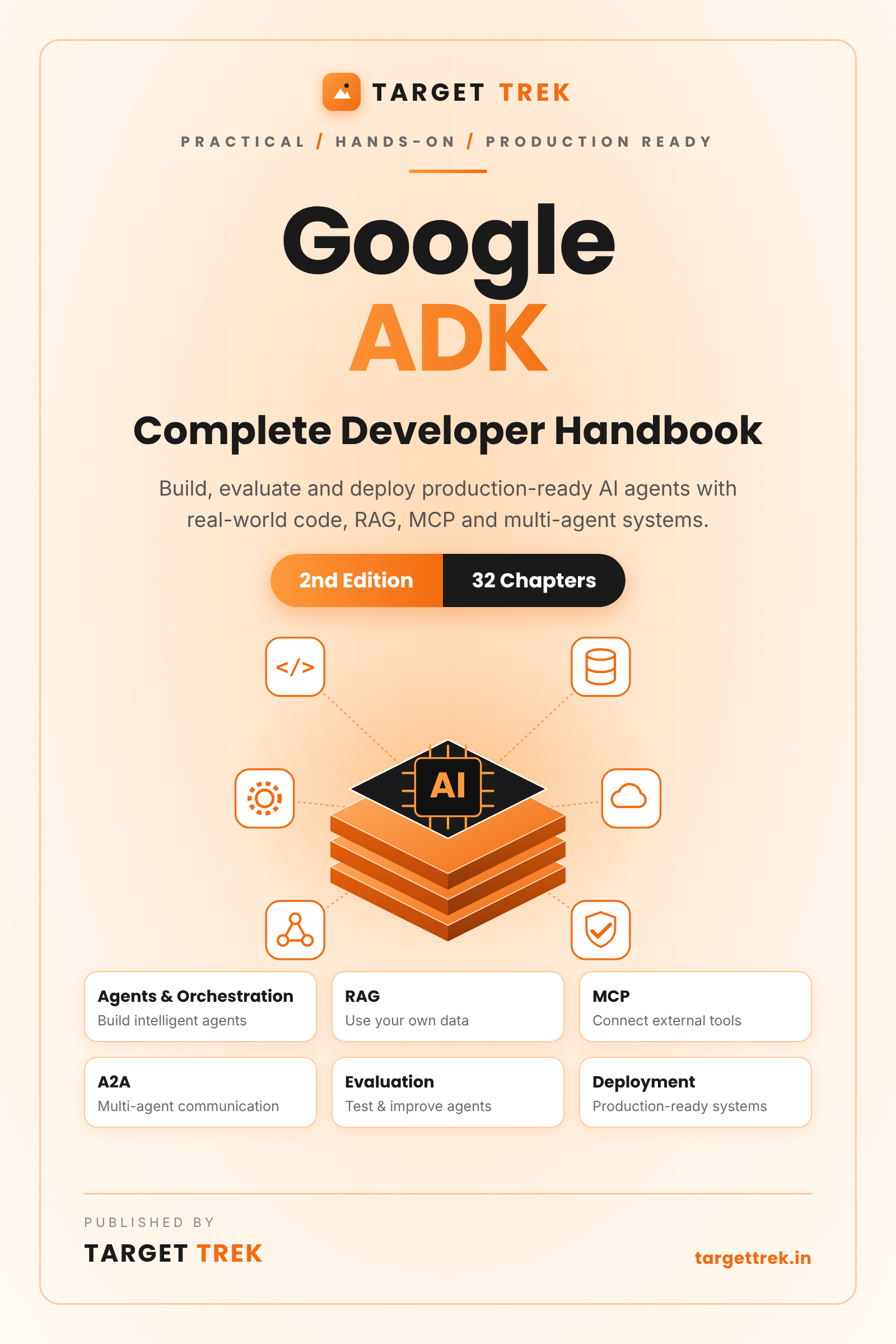
Google ADK Complete Developer Handbook ebook coverPDF ebook
Built for developers

Go from AI experiments to real agent systems

A structured engineering handbook that connects agent fundamentals with implementation, orchestration, integrations, testing and production deployment.

  • Structured learning

    Progress from first principles through agents, tools, integrations and production engineering.

  • Code-first approach

    Learn through Python snippets, application flows, commands and implementation concepts.

  • Connect the ecosystem

    See how Google ADK works with RAG, MCP, A2A, models and APIs.

  • Production awareness

    Evaluation, observability, testing, security, reliability and deployment.

System architecture

How an AI agent actually works

How a request reaches an agent, how the agent calls tools and services, and how the result comes back through your application.

  1. requestUser / API

    Receives the incoming request.

  2. planADK agent

    Plans and selects tool calls.

  3. actTools / workflow

    Runs authorized operations.

  4. verifyData / services

    Returns verified application data.

Keep in mind: the agent may choose actions, but your application services still enforce authentication, authorization, validation and safety checks. The handbook covers these controls alongside orchestration.
What you will master

Everything you need to build with Google ADK

The framework's most important building blocks and how they fit together in practical projects.

  • LLM agents

    Create agents using instructions, models, tools, state and sessions.

  • Orchestration

    Compose sequential, parallel and loop-based agent workflows.

  • Tools & APIs

    Connect agents to deterministic functions, external services and data.

  • RAG

    Build retrieval-aware agents and grounded response flows.

  • MCP & A2A

    Protocol-based integrations and specialist agent communication.

  • State & memory

    Work with context, persistent information, sessions and state.

  • Evaluation

    Measure agent quality and build an evaluation and regression workflow.

  • Deployment

    Runtime, cloud infrastructure, security and production operations.

Your learning journey

Seven steps from beginner to production

A practical progression through what you need to design, implement, evaluate and deploy agent systems.

  1. Step 01Python + LLM Foundations

    Python, LLM APIs, prompting, context windows, structured outputs and basic interactions.

    Models, prompts and context
  2. Step 02Agent Fundamentals

    How models, tools, instructions, sessions and state form an agent.

    Instructions, state and sessions
  3. Step 03Tools & Function Calling

    Give agents controlled access to application logic, databases and external services.

    APIs, files and controlled actions
  4. Step 04RAG & Memory

    Use retrieval to ground answers and state or memory to keep useful context.

    Retrieval and grounding
  5. Step 05Multi-Agent & Protocols

    Orchestrate specialist agents and connect systems using protocols.

    Workflows, MCP and A2A
  6. Step 06Evaluation & Observability

    Evaluate quality, trace executions, diagnose failures and improve behavior.

    Tests, traces and guardrails
  7. Step 07Production Engineering

    Expose agents with APIs and implement security, monitoring and reliability.

    Deployment and security
Complete contents

32 chapters. One complete developer handbook.

From the first ADK agent through tool calling, multi-agent orchestration, RAG, MCP, A2A, evaluation, observability, FastAPI and deployment.

Foundations

The building blocks

  1. 01
    Agentic AI Fundamentals

    Agent loops, tools, context, memory, workflows and when agents make sense.

  2. 02
    Google ADK: What It Is & Where It Fits

    Understand ADK, the developer workflow and the Agents CLI.

  3. 03
    Setup, Installation & Authentication

    Install ADK, configure Gemini or Vertex AI and create your first agent.

  4. 04
    Project Structure & Developer Workflow

    Organize agents, services, tests, evaluation datasets and deployment files.

  5. 05
    LlmAgent: The Core Agent Type

    Build LLM-powered agents and understand the decision and tool-use loop.

Learn with real Python

From the first agent to multi-agent workflows

Code from the handbook: create an agent, add tools, retrieve knowledge and orchestrate several agents.

Build your first AI agent

Start with the core Google ADK agent primitive and define its model, instructions and purpose.

  • Google ADK examples
  • Python implementation
  • Developer-oriented explanations
agent.py
from google.adk.agents import Agent

root_agent = Agent(
    name="support_agent",
    model="gemini-flash-latest",
    instruction="""
    You are a customer-support assistant.
    Be concise.
    Never invent account data.
    Use tools when account information
    is required.
    """,
)
Practical implementation

Learn by building useful AI agents

Beyond an isolated Hello World: agents that research, call APIs, retrieve knowledge and cooperate.

  • Project 01

    Research agent

    An agent that researches a topic, gathers information and returns structured findings.

    Research · Tools · Structured output
  • Project 02

    API agent

    Connect agents to external APIs and run application actions with controlled function calls.

    APIs · Python · Function calling
  • Project 03

    RAG agent

    An agent that answers questions from your documents and knowledge base.

    Embeddings · Retrieval · Grounding
  • Project 04

    Multi-agent system

    Specialist agents orchestrated into a complete AI workflow.

    Sequential · Parallel · Orchestration
Production engineering

Building an agent is just the beginning

The engineering that turns a prototype into a reliable, observable, secure and maintainable application.

  • Evaluation

    Build datasets, inspect output quality and detect regressions before deployment.

  • Observability

    Trace agent interactions, monitor tool calls and investigate failure patterns.

  • Security

    Protect private information, validate tool arguments and enforce access control.

  • Deployment

    Expose agents through FastAPI and explore cloud runtimes and operational concerns.

The handbook approach

A structured path alongside the official docs

Official documentation stays the source of truth for SDK behavior. This handbook organises the journey: concepts, implementation, production concerns and examples.

  • Where should I start?FundamentalsSetupFirst agent
  • How do the concepts connect?ConceptFlowCode
  • What comes after basic agents?ToolsWorkflowsRAGProtocols
  • How should I prepare for production?EvaluationObservabilitySecurityDeployment
Choose your book

The GenAI interview series

Three books that fit together: RAG for grounding answers in your data, MCP for connecting models to tools, and Google ADK for building the agents that use both.

This page
AI agents · Google ADK

Google ADK Complete Developer Handbook

Agents, tools, sessions, memory, multi-agent orchestration, guardrails, evaluation, RAG, MCP and deployment.

  • 32 chapters
  • Single and multi-agent systems
  • Production practices
₹149₹39963% off
Model Context Protocol

Master GenAI Interview- MCP

Hosts, clients, servers, JSON-RPC, STDIO and HTTP transports, FastMCP, LangChain and a full authenticated Python project.

  • 16 chapters in 4 stages
  • FastMCP servers and clients
  • Complete reminder application
₹49₹19975% off
Details
Retrieval-Augmented Generation

Master GenAI Interview - RAG PIPELINE

Ingestion, chunking, embeddings, vector databases, retrieval, re-ranking, evaluation and production RAG with LangChain.

  • 25 chapters in 5 stages
  • Offline and online pipelines
  • Vector database guide
₹59₹19970% off
Details
Questions

Before you buy

Anything else? Write to [email protected]

Who is this ebook for?

It is designed for developers, backend engineers, GenAI learners and software engineers who want a practical path from Google ADK fundamentals to production-oriented agent systems.

What is covered in the 2nd Edition?

The handbook contains 32 chapters covering agents, tools, workflow agents, sessions and memory, RAG, MCP, A2A, models, streaming, artifacts, evaluation, observability, deployment, FastAPI, security, testing, performance and production checklists.

Does the ebook contain code and commands?

Yes. It follows a concept → flow → code → commands → production notes approach with implementation examples throughout the handbook.

Is prior Google ADK experience required?

No. The handbook starts with fundamentals and setup before moving into advanced orchestration, integrations, evaluation and deployment.

Is this a video course?

No. It is a developer-focused digital ebook and reference handbook designed to accompany hands-on implementation.

Is the ebook refundable?

No. Due to the digital nature of the ebook, all purchases are non-refundable. Please review the contents and FAQ before purchasing.

How can I get support?

For purchase or ebook-related issues, contact [email protected].

From your first agent to production AI systems.

Google ADK fundamentals, multi-agent workflows, RAG, MCP, A2A, evaluation, observability and deployment in one code-first handbook.

₹149₹39963% off
Resume Lab by Target Trek

Applying everywhere but getting no interview calls?

Your book gets you ready for the interview. A better resume gets you the call. See exactly which lines cost you shortlists, and how to fix each one.

~2 min
AI report
Real people
review it
Pay once
no subscription
Google ADK Complete Developer Handbook
₹149₹39963% off