Skip to content
AWS handbook · PDF ebook · updated for 2025–26

Learn AWS the way you’ll use it at work, from first account to production.

14 parts through IAM, EC2, Lambda, containers, S3, DynamoDB, VPC, security, Bedrock, infrastructure as code and FinOps. Hands-on CLI examples in every service chapter, plus 2 reference architectures, 4 labs and interview questions.

14
parts
52
chapters
4
hands-on labs
7
appendices
₹149₹39963% off
  • Secure checkout via Razorpay
  • Digital PDF ebook
  • Read on phone, tablet or laptop
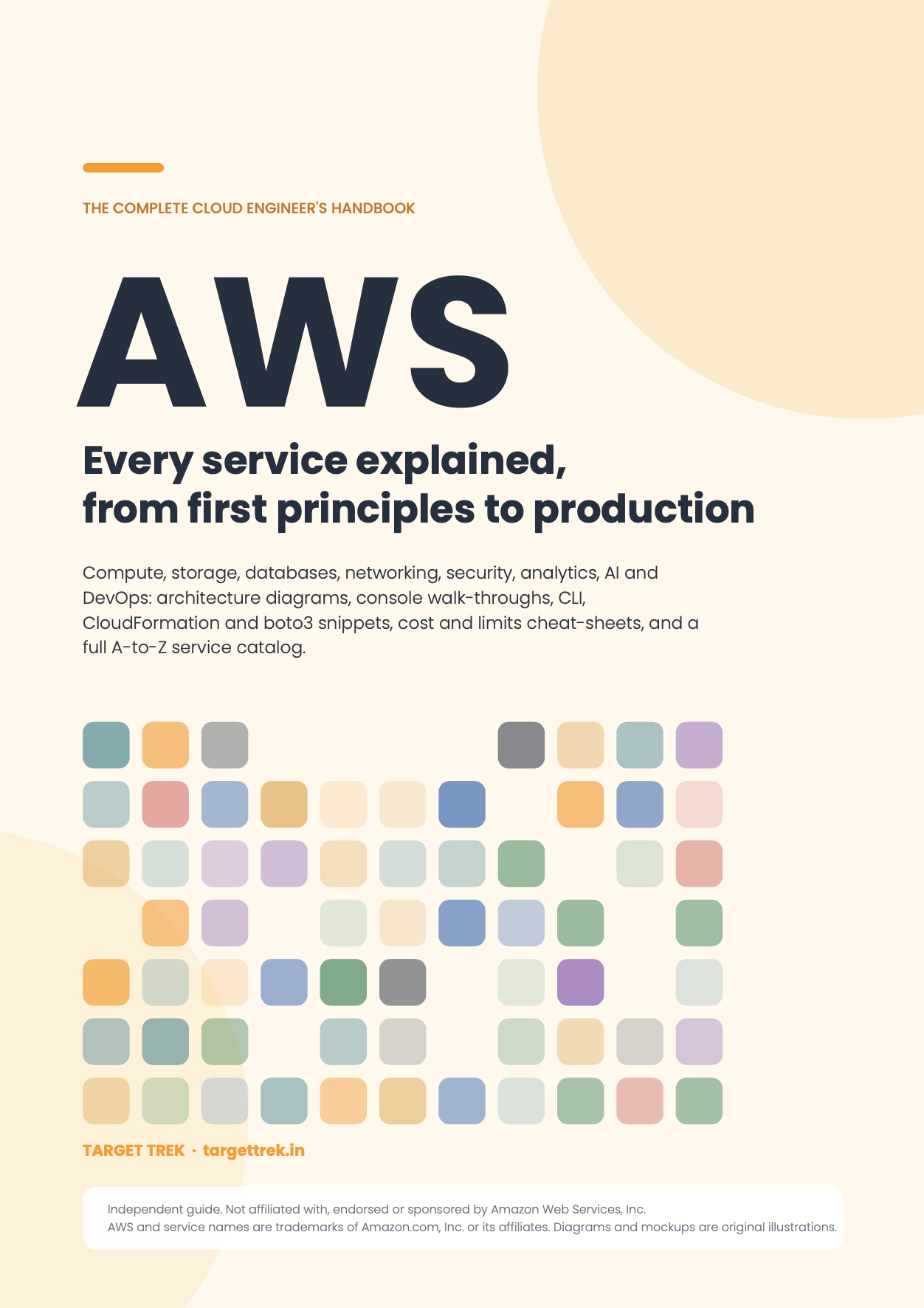
AWS Cloud ebook coverPDF ebook
In short

What is AWS: The Complete Cloud Engineer's Handbook?

AWS: The Complete Cloud Engineer's Handbook is a 14-part PDF ebook by Target Trek that teaches Amazon Web Services from foundations to production: global infrastructure, accounts and IAM, compute (EC2, Lambda, containers), storage, databases, networking, security, application integration, analytics, AI with Amazon Bedrock, infrastructure as code, observability and cost management. It includes two reference architectures, four hands-on labs, an AWS CLI cheat sheet and interview and certification questions, and covers what changed in 2025 and 2026.

Inside the PDF

  • 14 parts from foundations to reference architectures
  • What it is → core concepts → hands-on → gotchas, in every service chapter
  • AWS CLI, CloudFormation, CDK, SAM and Terraform examples
  • 2 reference architectures and 4 hands-on labs
  • What changed in 2025 to 2026: launches, renames, lifecycle notices
  • Appendices: CLI cheat sheet, quotas, interview questions, glossary, A–Z index
₹149₹39963% off
Choose your book

AWS or Google Cloud: pick your platform

Both handbooks take the same route: foundations, identity, compute, data, networking, security, AI, delivery and cost. Pick the cloud your team or target job uses.

This page
AWS

AWS Cloud

Amazon Web Services from your first account to production: 14 parts, 4 hands-on labs, 2 reference architectures and 7 appendices, updated for 2025–26.

  • 14 parts from foundations to reference architectures
  • What it is → core concepts → hands-on → gotchas, in every service chapter
  • AWS CLI, CloudFormation, CDK, SAM and Terraform examples
₹149₹39963% off
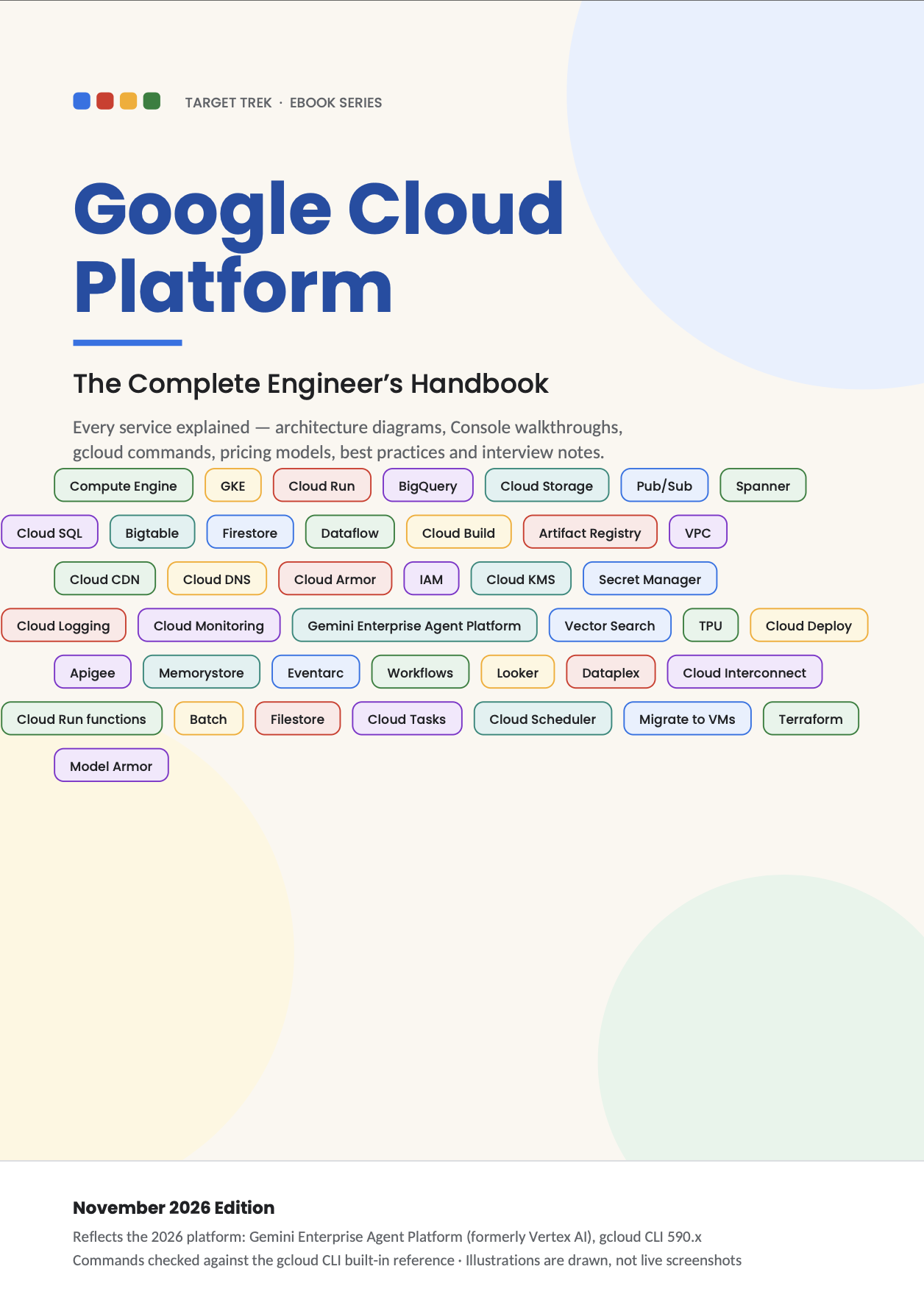
Google Cloud

Google Cloud Platform

The same end-to-end approach for Google Cloud: IAM, GKE, Cloud Run, BigQuery, Pub/Sub, networking, security and AI.

  • 18 parts, 12-part template for every service
  • 5 reference architectures
  • Certifications, interview questions, gcloud cheat sheet
₹149₹39963% off
Details
Free · try before you buy

Free AWS CLI samples from the book

Real commands in the style of the book's hands-on sections, each with sample output and the point interviewers want to hear.

Part 1 · Tools

Sign in with SSO instead of long-lived keys

Use IAM Identity Center so the CLI gets short-lived credentials, then confirm who you are.

Interview tip: Prefer temporary credentials and roles over access keys that never expire.

login.sh
# One-time setup of a named profile
aws configure sso --profile dev

# Sign in (opens your browser)
aws sso login --profile dev

# Which identity am I using?
aws sts get-caller-identity --profile dev
Sample output
{
  "UserId": "AROA...:[email protected]",
  "Account": "123456789012",
  "Arn": "arn:aws:sts::123456789012:assumed-role/..."
}
Service picker

Which AWS service should you use?

The common decisions, with the service to pick, why, and where the book goes deeper.

  • Run code on events, no servers to manageAWS Lambda

    Upload a function and AWS runs it when something happens. You pay for execution time, not idle servers.

    Mind the limits that shape designs, such as maximum run time.

    Part 3 · AWS Lambda
  • Full control of a virtual machineAmazon EC2

    Resizable virtual machines with a choice of instance families and purchase options.

    Pair with Auto Scaling and a load balancer for resilience.

    Part 3 · Amazon EC2
  • Run containers without managing serversAmazon ECS on Fargate

    Run containers on ECS with Fargate so AWS manages the underlying compute.

    Choose EKS when you specifically need Kubernetes.

    Part 3 · Containers on AWS
  • Store files and objects at any scaleAmazon S3

    Object storage with storage classes, lifecycle rules, events and replication.

    Use EBS for block storage and EFS for shared file storage.

    Part 4 · Amazon S3
  • Key-value data with predictable low latencyAmazon DynamoDB

    A managed NoSQL database where you design tables around your access patterns.

    Choose RDS or Aurora when you need relational SQL.

    Part 5 · Amazon DynamoDB
  • A relational database for an applicationAmazon RDS or Aurora

    Managed relational databases that handle patching, backups and failover.

    The Choosing a Database chapter compares every option.

    Part 5 · RDS and Aurora
  • Decouple services with queues and eventsSQS, SNS and EventBridge

    Queues, pub/sub topics and event routing let producers and consumers evolve independently.

    The chapter ends with how to choose among the three.

    Part 8 · SQS, SNS and EventBridge
  • Add generative AI to an applicationAmazon Bedrock

    Call foundation models through one service, add retrieval (RAG) and apply guardrails.

    Go further with Bedrock AgentCore for agents.

    Part 10 · Amazon Bedrock
Learning path

Six stages, from first account to production

Read it front to back as a course, or jump to the part you need. Each stage builds on the one before.

  1. 1
    Start Here · Part 1Start & Foundations

    How to read the book, what changed in 2025 and 2026, Regions, accounts, pricing and tooling.

  2. 2
    Parts 2–3Identity & Compute

    IAM policies and roles, then EC2, Auto Scaling, Lambda and containers.

  3. 3
    Parts 4–5Storage & Databases

    S3, EBS, EFS, FSx, RDS, Aurora, DynamoDB and caching.

  4. 4
    Parts 6–7Network & Security

    VPC, Route 53, CloudFront, API Gateway, KMS, Secrets Manager and threat detection.

  5. 5
    Parts 8–10Integrate, Analyse & AI

    SQS, SNS, EventBridge, Step Functions, Athena, Glue, Redshift, Bedrock and SageMaker AI.

  6. 6
    Parts 11–14 · AppendicesShip, Govern & Practise

    IaC, CI/CD, observability, FinOps, reference architectures, labs and interview questions.

How each service chapter is written

Most service chapters take the same four steps, so you always know where to find the concept, the command or the trap.

  1. 01
    What it is

    A plain explanation of the service and the problem it solves.

  2. 02
    Core concepts

    The vocabulary and building blocks you must know.

  3. 03
    Hands-on

    AWS CLI and infrastructure-as-code examples you can run.

  4. 04
    Gotchas

    Limits and traps that catch engineers in production.

Full table of contents

Every part and chapter of the AWS handbook

Every part starts closed. Open one to see its chapters, or search for a service to check it's covered.

16 sections · 63 chapters

StartStart Here3 chapters · How the book works, the whole AWS map on one page and what changed across 2025 and 2026.
  1. About This Book
    • How every chapter is structured
    • Callout legend
    • What "verified" means in this edition
    • Reading paths
  2. The AWS Map in One Page
    • The twelve building blocks
  3. What Changed in 2025 to 2026
    • Headline launches and renames
    • Lifecycle notices to design around
    • Runtime and version snapshot
01Foundations5 chapters · Regions, accounts, the shared responsibility model, tooling and how AWS pricing really works.
  1. Global Infrastructure
    • Global, regional and zonal services
    • How to choose a Region
    • Gotchas
  2. Accounts, Organizations and Control Tower
    • Recommended account layout
    • Creating and guarding accounts
  3. Shared Responsibility and the Well-Architected Framework
    • The shared responsibility model
    • The six Well-Architected pillars
    • Design principles to apply everywhere
  4. Tools: Console, CLI, SDKs and Infrastructure as Code
    • Credentials: the safe way
    • CLI techniques worth learning early
  5. How AWS Pricing Works
    • The three pricing ideas
    • Cost dimensions by service family
    • Purchase options for compute
    • The Free Tier
    • Five cost levers that matter most
02Identity and Access Management2 chapters · Policies, evaluation logic, roles, federation and the habits that keep an account safe.
  1. AWS IAM
    • Anatomy of a policy
    • Policy evaluation logic
    • Identity-based versus resource-based policies
    • Roles and temporary credentials
    • Hands-on: a least-privilege role from the CLI
    • Attribute-based access control (ABAC)
    • Root user and account hygiene
    • Limits worth knowing
    • Gotchas
  2. IAM Identity Center, Federation and Cognito
    • IAM Identity Center
    • Amazon Cognito
    • Other identity services
    • Federating GitHub Actions without stored keys
03Compute5 chapters · EC2, Auto Scaling, load balancing, Lambda and containers on ECS, Fargate, ECR and EKS.
  1. Amazon EC2
    • Instance families at a glance
    • Launch an instance (CLI)
    • Purchasing, lifecycle and states
    • Security baseline
    • CloudFormation: a launch template
    • Gotchas
  2. EC2 Auto Scaling and Elastic Load Balancing
    • Auto Scaling concepts
    • Load balancer types
    • Build it from the CLI
    • Gotchas
  3. AWS Lambda
    • Limits that shape designs
    • Supported runtimes
    • Write, package and deploy
    • The same function with AWS SAM
    • Performance and cost tuning
    • Gotchas
  4. Containers on AWS: ECS, Fargate, ECR and EKS
    • Choosing a container service
    • Amazon ECS
    • Amazon ECR
    • Amazon EKS
  5. Other Compute Services
04Storage3 chapters · S3 in depth, block and file storage, backup, data transfer and hybrid storage.
  1. Amazon S3
    • Storage classes
    • Security: the checklist
    • Hands-on with the CLI
    • Replication, events and other features
    • New data-centric S3 capabilities
    • Gotchas
  2. Block and File Storage: EBS, EFS and FSx
    • Amazon EBS
    • Amazon EFS
    • Amazon FSx
  3. Backup, Transfer and Hybrid Storage
    • AWS Backup
    • Data movement and hybrid services
05Databases4 chapters · Choose the right database, then go deep on RDS, Aurora, DynamoDB and caching.
  1. Choosing a Database on AWS
  2. Amazon RDS and Aurora
    • Core concepts
    • Hands-on
    • Operational practice
  3. Amazon DynamoDB
    • Core concepts
    • Designing for DynamoDB
    • Limits worth memorising
  4. ElastiCache, MemoryDB and the Specialised Databases
    • In-memory
    • Document, graph, wide-column and time series
    • Migration and modernisation tools
06Networking and Content Delivery3 chapters · VPC, DNS, CDN, APIs and how to connect networks together.
  1. Amazon VPC
    • Security groups versus network ACLs
    • Hands-on
    • Gotchas
  2. Route 53 and CloudFront
    • Amazon Route 53
    • Amazon CloudFront
  3. API Gateway, Hybrid Networking and Service Connectivity
    • Amazon API Gateway
    • Connecting networks
07Security and Compliance3 chapters · Encryption, secrets, threat detection, auditing and a baseline for every new account.
  1. Encryption and Secrets: KMS, Secrets Manager, ACM
    • AWS Key Management Service (KMS)
    • Secrets Manager and Parameter Store
    • Certificates and other cryptographic services
  2. Threat Detection, Compliance and Auditing
    • The detection and governance services
    • Turn on the essentials organisation-wide
    • A pragmatic baseline for every new account
  3. Edge and Network Protection
08Application Integration3 chapters · Decouple systems with queues, topics, events, workflows and streaming.
  1. SQS, SNS and EventBridge
    • Why decouple
    • The three building blocks
    • Amazon SQS in detail
    • SNS and EventBridge in practice
    • Choosing among them
  2. Step Functions, AppSync and Messaging Services
    • AWS Step Functions
    • Other application-integration services
  3. Streaming: Kinesis, MSK and Firehose
09Analytics and Data3 chapters · Data lakes and lakehouses, Athena, Glue, Redshift, OpenSearch and business intelligence.
  1. The Data Lake and Lakehouse on AWS
    • The core services
    • Design principles
  2. Athena and Glue in Practice
    • Amazon Athena
    • AWS Glue ETL (PySpark)
  3. Redshift, OpenSearch and Business Intelligence
    • Amazon Redshift
    • Amazon OpenSearch Service
    • Amazon Quick (formerly Amazon QuickSight)
    • Choosing an analytics engine
10AI and Machine Learning4 chapters · Amazon Bedrock, RAG, guardrails, agents, SageMaker AI and ready-made AI services.
  1. Amazon Bedrock
    • Discover models and call one
    • Retrieval-augmented generation (RAG)
    • Guardrails
  2. Bedrock AgentCore and the Agentic AWS Services
    • Amazon Bedrock AgentCore
    • Agents that work on AWS for you
  3. Amazon SageMaker AI and Custom Machine Learning
    • What it is
    • AWS ML silicon
  4. Ready-Made AI Services
11Developer Tools and Observability3 chapters · Infrastructure as code, CI/CD, deployment strategies and observability.
  1. Infrastructure as Code: CloudFormation, CDK, SAM and Terraform
    • Why IaC
    • CloudFormation essentials
    • CDK in Python
    • Terraform backend and a resource
  2. CI/CD and Developer Services
    • A buildspec for CodeBuild
    • GitHub Actions deploying with OIDC (no stored keys)
    • Deployment strategies
  3. Observability: CloudWatch, X-Ray and OpenTelemetry
    • Amazon CloudWatch
    • Tracing and open standards
    • Alarming principles
12Management, Governance and Cost3 chapters · Operate fleets, govern accounts and keep the bill under control.
  1. Systems Manager and Fleet Operations
  2. Governance: Organizations, Control Tower, Config and Service Catalog
  3. Cost Management and FinOps
    • Cost reduction checklist
13The Long Tail of AWS Services5 chapters · The wider catalogue beyond the core, grouped so you know what else exists.
  1. Migration and Transfer
  2. Internet of Things
  3. Media, Games and Customer Engagement
  4. End-User Computing
  5. Specialised Services
14Reference Architectures and Hands-On Labs6 chapters · Two reference architectures and four labs, from securing an account to cleaning up.
  1. Reference Architecture: Three-Tier Web Application
  2. Reference Architecture: Event-Driven Serverless
  3. Lab 1: Secure a New Account
  4. Lab 2: Static Site with CloudFront
  5. Lab 3: Serverless API
  6. Lab 4: Clean Up
A–GAppendices and Index8 chapters · Service catalogue, CLI cheat sheet, quotas, interview questions, glossary, version snapshot and an A–Z index.
  1. Appendix A: Service Catalog by Category
  2. Appendix B: AWS CLI Cheat Sheet
  3. Appendix C: Common Limits and Quotas
  4. Appendix D: Interview and Certification Questions
  5. Appendix E: Glossary
  6. Appendix F: Lifecycle and Version Snapshot
  7. Appendix G: Learning Resources
  8. A–Z Index
Put it together

2 reference architectures and 4 hands-on labs

Part 14 ties the services together, then you build, secure and clean up in your own account.

  • Reference 1
    Three-Tier Web Application

    A classic layered design: edge, application tier and database.

    1. Route 53
    2. CloudFront
    3. Load Balancer
    4. EC2 / ECS
    5. RDS / Aurora
  • Reference 2
    Event-Driven Serverless

    Managed building blocks wired together by events, with no servers to run.

    1. API Gateway
    2. Lambda
    3. EventBridge
    4. SQS
    5. DynamoDB

4 hands-on labs

  1. 1
    Lab 1: Secure a New Account

    Apply the account baseline from the security and governance chapters.

  2. 2
    Lab 2: Static Site with CloudFront

    Publish a website and serve it through the content delivery network.

  3. 3
    Lab 3: Serverless API

    Build an API with the serverless building blocks from earlier parts.

  4. 4
    Lab 4: Clean Up

    Remove what you created so lab resources never turn into a surprise bill.

Who it's for

Made for engineers who build on AWS

  • Developers moving to the cloud

    Start from Regions, accounts and IAM, then build with Lambda, S3 and DynamoDB.

  • DevOps, cloud and platform engineers

    IaC with CloudFormation, CDK, SAM and Terraform, CI/CD with OIDC, observability and governance.

  • Data and ML engineers

    Data lakes, Athena, Glue, Redshift, OpenSearch, Bedrock and SageMaker AI.

  • Interview and certification candidates

    Interview and certification questions, limits and quotas, and a CLI cheat sheet to revise from.

What you get

  • 14 parts plus 7 appendices

    From global infrastructure to reference architectures, then a catalogue, cheat sheet, glossary and A–Z index.

  • Hands-on in every service chapter

    CLI commands and infrastructure-as-code examples you can run in your own account.

  • 2 reference architectures and 4 labs

    Three-tier web app and event-driven serverless, then secure an account, ship a site, build an API, clean up.

  • Current for 2025–26

    A chapter on launches, renames, lifecycle notices and a runtime snapshot.

₹149₹39963% off

Digital PDF, shown on screen and sent by email after payment. Digital purchases are not refundable. Help: [email protected]

Build on AWS with a plan, not a pile of browser tabs.

14 parts, hands-on CLI examples, 4 labs and interview questions in one digital PDF you can read anywhere.

₹149₹39963% off
Resume Lab by Target Trek

Applying everywhere but getting no interview calls?

Your book gets you ready for the interview. A better resume gets you the call. See exactly which lines cost you shortlists, and how to fix each one.

~2 min
AI report
Real people
review it
Pay once
no subscription
AWS: The Complete Cloud Engineer's Handbook
₹149₹39963% off