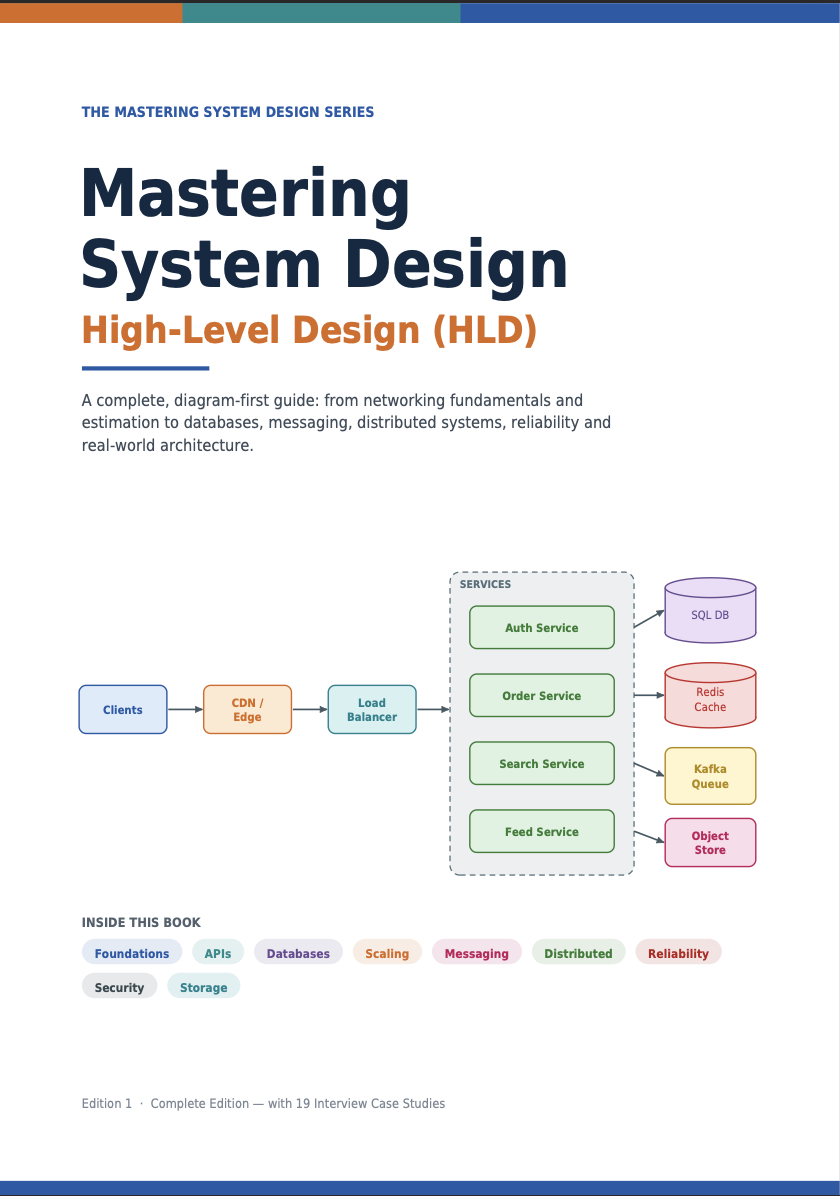
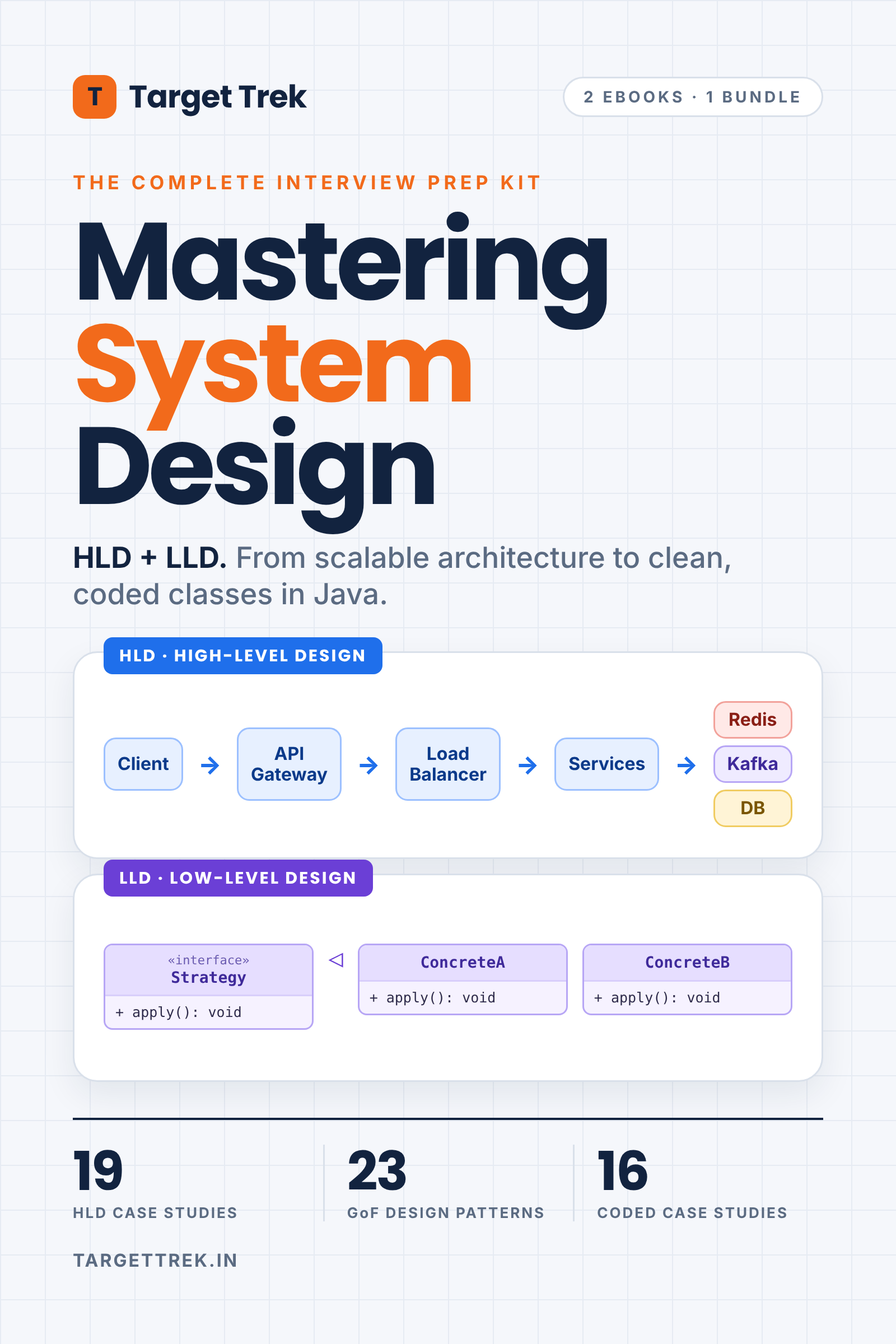
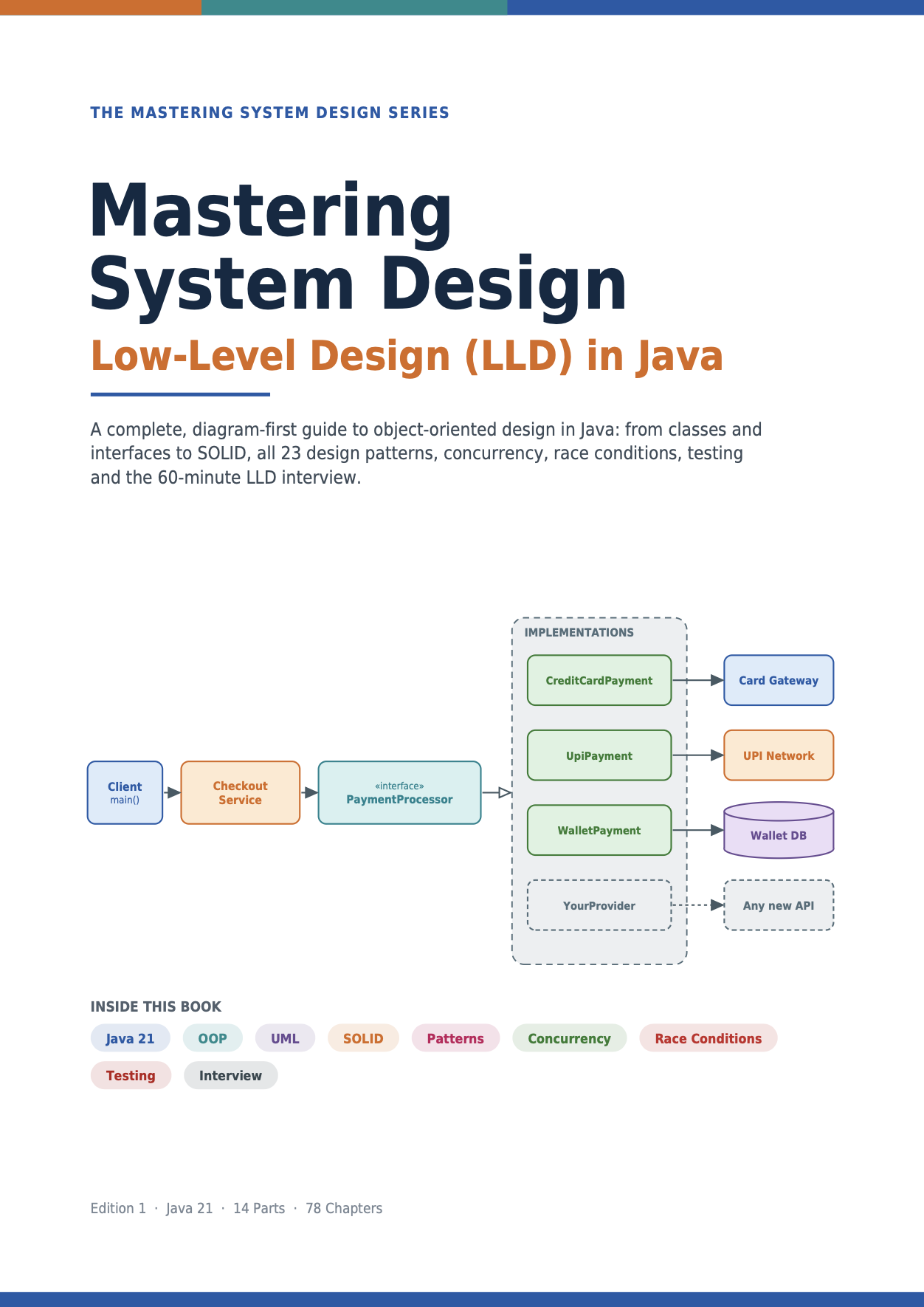
Mastering System Design LLD
How one service is built: classes, relationships, SOLID, design patterns, concurrency and working Java.
- 16 coded LLD case studies
- All 23 GoF design patterns
- 60-minute interview framework
Turn requirements into classes, relationships and patterns, then into working Java. Learn OOP, SOLID, all 23 GoF patterns and concurrency, and practise on 16 real problems like BookMyShow, Splitwise and a rate limiter.
PDF ebookLLD is how one service is built in code. HLD is how the whole system scales. Most product companies ask both, and the combo covers both rounds.

How one service is built: classes, relationships, SOLID, design patterns, concurrency and working Java.

Architecture for the whole system: requirements, estimates, APIs, data stores, caching, queues and failures.

Practical Java class design in LLD, plus distributed architecture and scalable backends in HLD.
| Topic | HLD | LLD (this book) |
|---|---|---|
| Focus | Architecture of the whole system | Class-level design inside one service |
| Core question | How does it scale to millions of users? | How do I model objects and relationships? |
| Artifacts | Components, APIs, data stores, queues | Classes, interfaces, patterns, working code |
| You decide | SQL vs NoSQL, caching, sharding, consistency | SOLID, design patterns, extensibility, concurrency |
Actual pages from the book. Use the arrows, the page strip, or your keyboard's arrow keys.
The problems product companies actually ask. Each one comes with a UML class diagram, a Java implementation and a runnable scenario. Filter by the pattern it uses.
16 of 16 case studies
Concurrency + Seat Locking
Model cities, theatres, screens and show-specific seats. Explore temporary seat holds, booking states, category pricing and safe cancellation.
Key classesMovie, Theatre, Screen, Show, Seat, Booking, Payment, User
Inventory + concurrency
Track product batches across warehouses, reserve stock during checkout, apply issuance policies and trigger low-stock notifications.
Key classesProduct, Inventory, Warehouse, StockItem, Order, Reservation
Object modeling + pricing
Allocate compatible spaces across parking floors, issue tickets and calculate fees with interchangeable pricing policies.
Key classesParkingLot, Floor, Spot, Vehicle, Ticket, PricingStrategy
Multiple channels
Coordinate email, SMS, push and in-app delivery with templates, preferences, priorities and bounded retry policies.
Key classesNotification, Channel, Template, UserPreference, NotificationDispatcher
Algorithms + thread safety
Compare fixed window, sliding window log, sliding window counter, token bucket and leaky bucket algorithms with concurrent requests.
Key classesRateLimiter, Algorithm, TokenBucket, SlidingWindow, Client
Thread safety + extensibility
Design named loggers, severity filters, pluggable appenders, formatters and synchronized writes.
Key classesLogger, LogLevel, LogHandler, ConsoleAppender, FileAppender
Booking + state transitions
Model trains, routes, coaches and berths with booking states, cancellation rules and waitlist promotion.
Key classesTrain, Station, Route, Coach, Seat, Passenger, Booking
Vehicle availability + pricing
Separate future reservations from active rentals, validate date ranges and compose rental pricing with optional add-ons.
Key classesVehicle, Car, Customer, Rental, Location, PricingStrategy
Strategy + domain modeling
Work with equal, exact and percentage splits, consistent rounding, balance sheets and debt settlement.
Key classesUser, Expense, Split, Group, Balance, SplitStrategy
Not a definition list. Each pattern comes with a real example and the signal that tells you to reach for it in an interview.
Ensures that a class has only one instance and provides a controlled access point.
Creates objects without exposing the exact object creation logic to the client.
Creates families of related objects without specifying their concrete classes.
Constructs complex objects step by step.
Creates new objects by copying an existing object.
Which pattern? A quick cheat sheet from the book
Start from OOP and work up to patterns, concurrency, Spring Boot and the interview itself.
Design trade-offs, requirements, class ownership, interview evaluation and incremental modeling.
Types, memory, interfaces, collections, generics, functional Java, exceptions and validation.
Encapsulation, abstraction, polymorphism, inheritance, composition, identity and dependency injection.
Class, sequence, activity, state and architecture diagrams, plus Mermaid and PlantUML.
SOLID, DRY, KISS, YAGNI, GRASP, code smells and safe refactoring.
Creational, structural and behavioral patterns, selection guidelines and combined applications.
Layered and clean architecture, domain-driven design, events, messaging and resilience patterns.
Thread lifecycle, Executor framework, CompletableFuture, Java Memory Model and advanced concurrency.
Race conditions, intrinsic/explicit locks, atomics, deadlocks and distributed consistency.
Choose efficient collections, build reusable in-memory components and analyze performance.
REST contracts, persistence, JPA/Hibernate, clean architecture, security and observability.
Unit, integration and concurrency testing, maintainability, quality and production readiness.
Scope requirements, communicate diagrams, write core code and handle follow-up questions.
Booking, inventory, parking, notifications, rate limiting, payments and more with Java implementations.
The book's ten-step framework. Every case study follows it, so you can apply it to a problem you have never seen.
Identify scope, actors and core use cases.
Extract nouns, domain objects and responsibilities.
Association, aggregation, composition and inheritance.
Decide which class owns which behaviour.
Find areas likely to change independently.
Use SOLID, KISS, DRY and low coupling.
Use patterns only where they solve a real problem.
Identify shared state and synchronisation needs.
Implement interfaces, classes and collaborations.
Explain alternatives and why your design works.
Learn OOP, SOLID, relationships and design patterns from the ground up.
Build the foundation required for machine coding and LLD interviews.
Improve design thinking, extensibility and tradeoff discussions.
Turn business requirements into clean object oriented services.
See how object oriented design, patterns, concurrency and locking become clean Java.
Practice realistic LLD questions with a structured design process.
What you get
Read on laptop, tablet or phone and revise anywhere.
From OOP and UML to Spring Boot, testing and production engineering.
Each with its purpose, a real example and when to reach for it.
UML class diagrams, Java implementations and runnable driver scenarios.
Threads, executors, the Java Memory Model, locks and deadlocks.
Scope, diagram, code the core and handle the follow-ups.
Anything else? Write to [email protected]
The book spans 14 parts: LLD foundations, Java language and OOP, UML, SOLID/GRASP, all 23 GoF patterns, enterprise and event-driven patterns, multithreading, locking, data structures, APIs, persistence, Spring Boot, security, testing, a 60-minute interview framework and 16 real-world design case studies.
Yes. The case studies include UML class diagrams, Java implementations and runnable driver scenarios for problems such as movie tickets, parking, inventory, notifications and rate limiting.
Yes. Dedicated chapters cover API design, database and persistence modeling, JPA/Hibernate, clean architecture with Java and Spring Boot, security, resilience and observability. Interview exercises can still focus on in-memory design where appropriate.
Yes. The book covers Java threads, executors, CompletableFuture, the Java Memory Model, locks, atomic operations, deadlocks, concurrent collections and related consistency issues.
LLD answers how one component is built: classes, interfaces, relationships, SOLID principles, design patterns and working code. HLD answers how a whole system scales: services, databases, caching, messaging and consistency. This page covers LLD; the HLD book and an HLD + LLD combo are linked on this page.
Yes. Real sample pages from the book are on this page. Read them right here, page by page, with no download or sign-up.
Pay once through our secure payment partner. The ebook is a digital PDF that you can read on your phone, tablet or laptop.
No. This is a digital PDF ebook.
No. Digital ebook purchases are non-refundable after successful payment.
Email [email protected] for purchase or ebook support.
23 patterns, 16 coded case studies and one interview method, in a digital PDF you can read anywhere.
Most resumes are rejected by software or skimmed in ten seconds. Find out exactly what is costing you shortlists, and how to fix it.
One-time payment · No subscription · Plans cannot be cancelled once bought