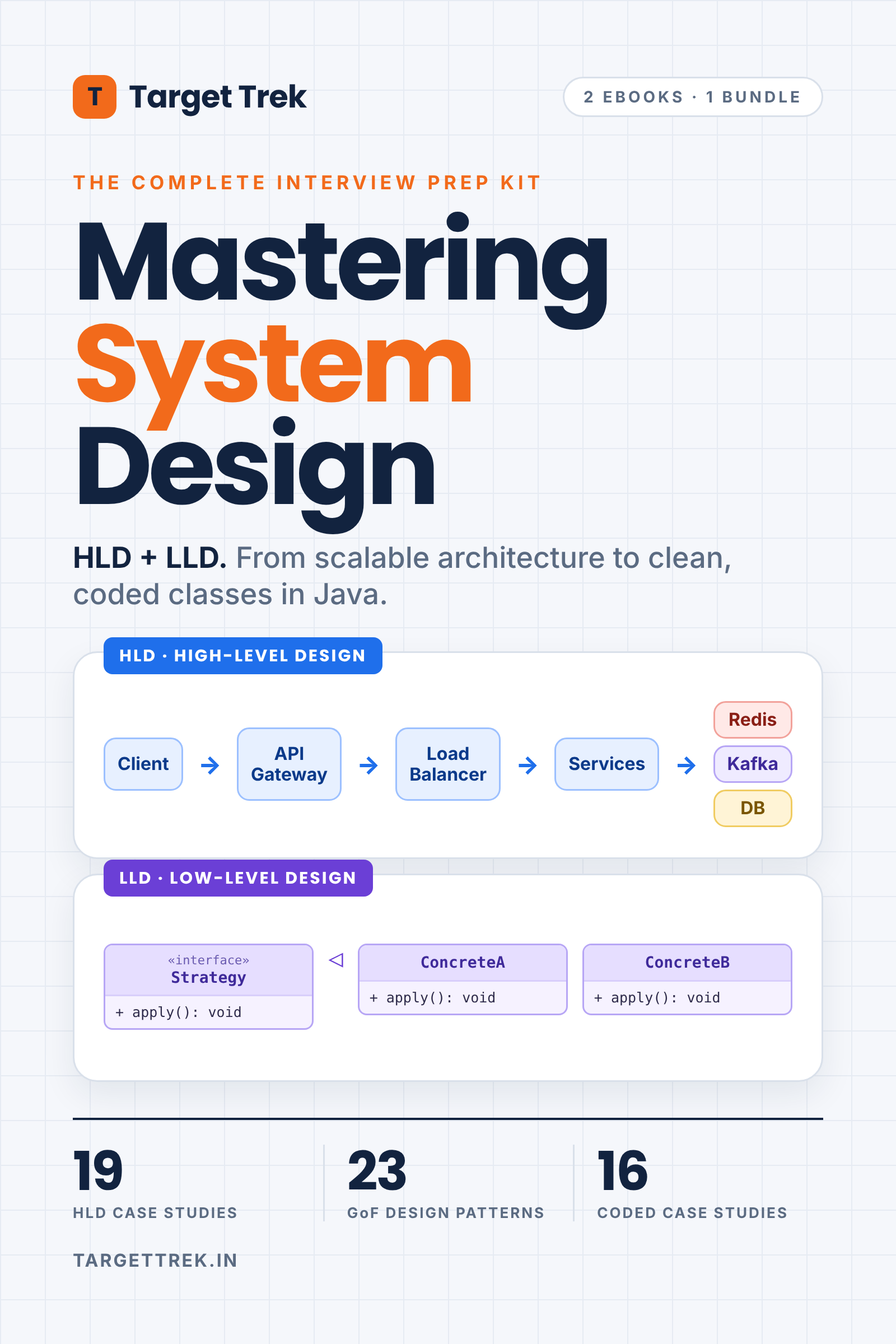
Crack the system design round with 19 real systems.
One repeatable method to turn an open prompt into requirements, estimates, APIs, data models, an architecture and failure handling. Practised on WhatsApp, Uber, BookMyShow, payments, Netflix and 14 more.
19
case studies
16
building blocks
9
steps per case
45
minute playbook
₹299₹59950% off
Secure checkout via Razorpay
Digital PDF ebook
Read on phone, tablet or laptop
PDF ebook
Choose your book
HLD, LLD, or both rounds together
HLD is how the whole system scales. LLD is how one service is built in code. Most product companies ask both, and the combo covers both rounds.
This page
High-level design
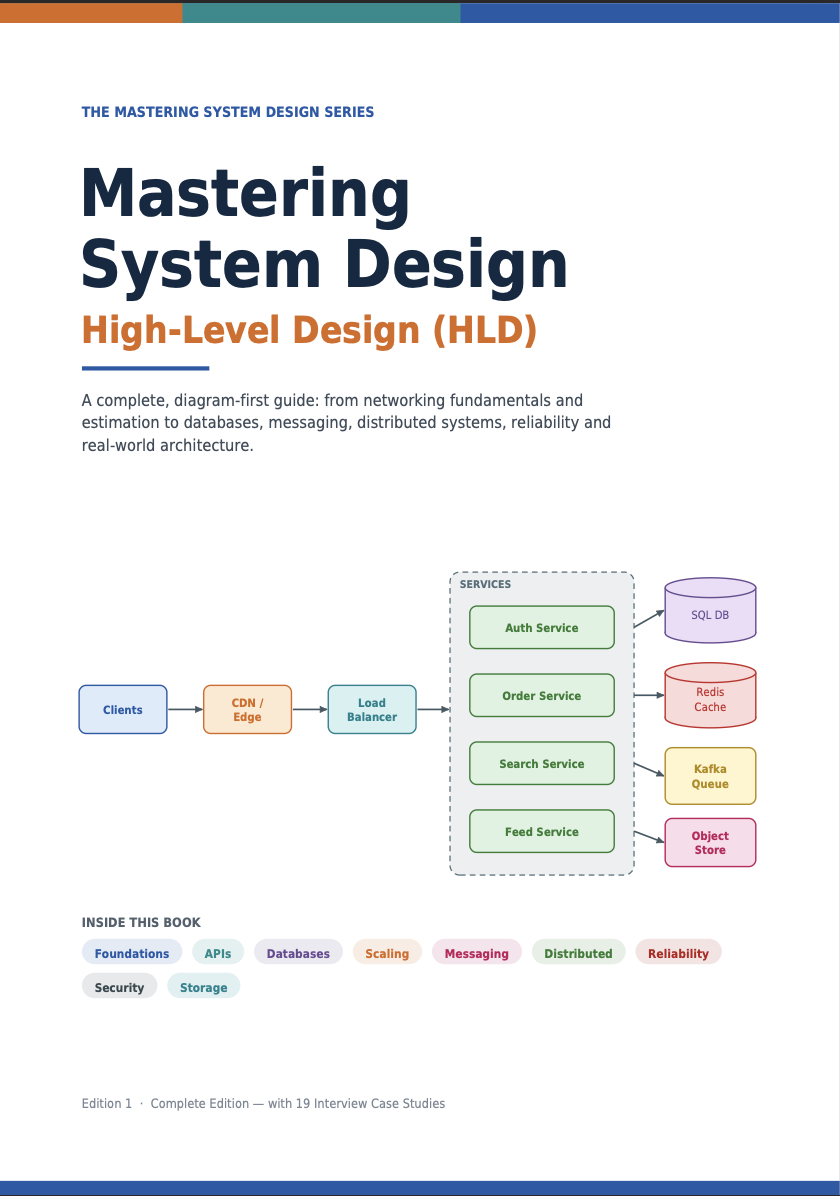
Mastering system design- high level design
Architecture for the whole system: requirements, estimates, APIs, data stores, caching, queues and failures.
19 HLD case studies
16 building-block primers
45-minute interview playbook
₹299₹59950% off
Low-level design · Java
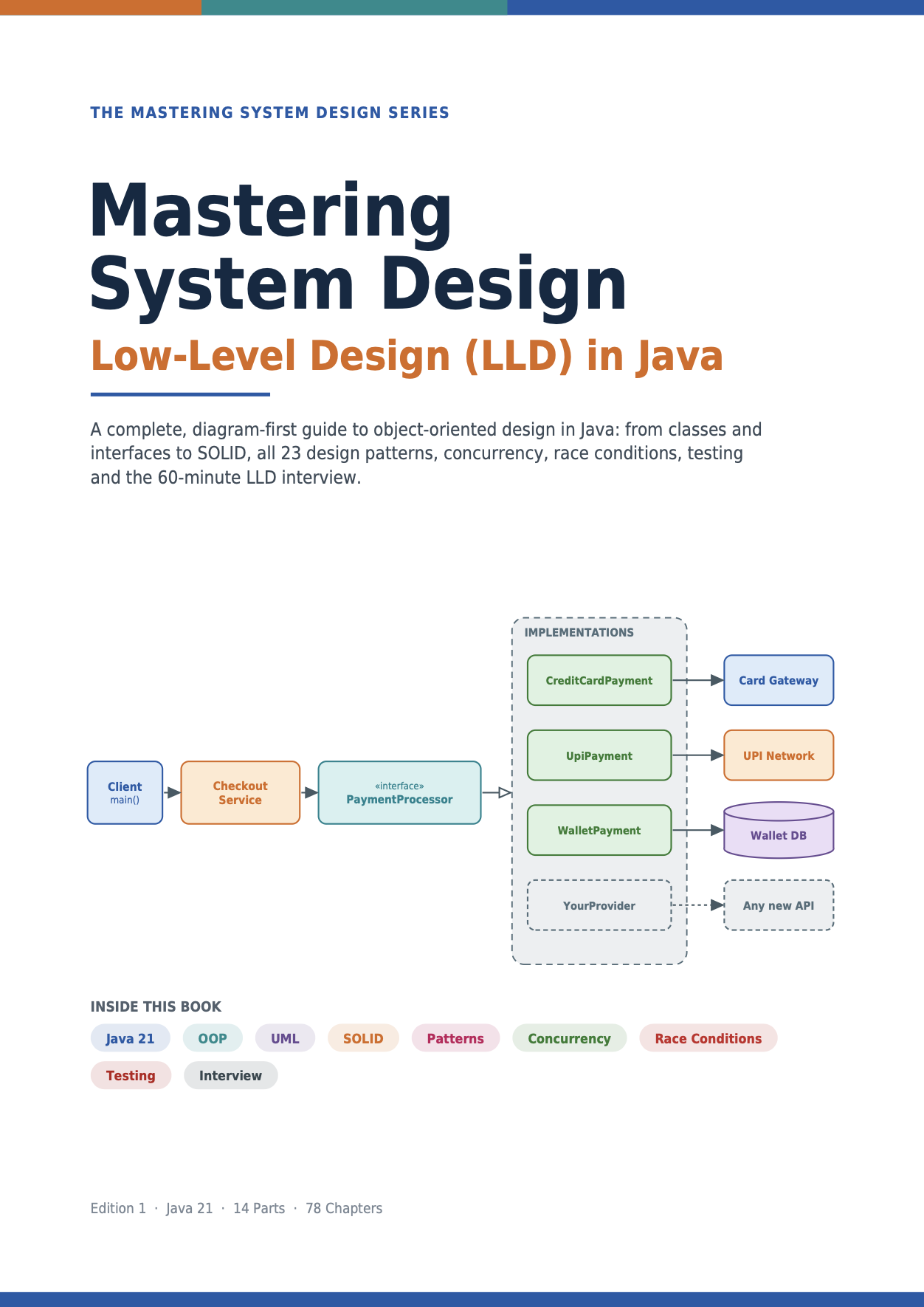
Mastering System Design LLD
Turn requirements into clean object models, apply SOLID and design patterns, and practise complete Java LLD problems.
Durable async backbone, replay, decoupling, partition ordering and burst absorption.
CDC
Stream database changes to search, caches and analytics without unsafe dual writes.
Elasticsearch
Full-text search, faceting, autocomplete support and read-optimized search indexes.
Object Store + CDN
Store large media blobs and deliver static/video content close to users.
SQL Databases
Transactions, relational integrity, locking, indexes and strongly consistent workflows.
NoSQL Databases
Horizontal scale for key-based, write-heavy and extremely large access patterns.
Sharding
Partition data by user, region, city, key-range or hash while controlling hot partitions.
Replication
Read scale, redundancy, failover, RPO/RTO choices and sync vs async replicas.
Rate Limiting
Token bucket, fixed/sliding windows, Redis atomicity and per-tenant policy enforcement.
Distributed Coordination
Leases, locks, compare-and-set, leader election and correctness under concurrency.
Service Architecture
Service boundaries, synchronous RPC, asynchronous events and graceful degradation.
Observability
Logs, metrics, tracing, queue lag, error rate and latency SLOs for production systems.
Security + Reliability
AuthN/AuthZ, secrets, encryption, retries, circuit breakers and idempotent operations.
Syllabus
What the book teaches across every system
01Requirements before architectureClarify first. Draw later.
Every case study starts by narrowing scope before choosing technology. The book separates user-facing features from the system qualities that change architecture.
Functional requirements and critical user flows
Latency, availability, durability and consistency targets
Scope boundaries: region, retention, media, payments, search and analytics
Interviewer follow-ups and red flags before the diagram begins
02Back-of-envelope estimationTurn vague scale into concrete numbers.
The handbook repeatedly estimates QPS, peak traffic, concurrent connections, storage, bandwidth and hot-set size so the architecture is tied to a scale assumption.
Average QPS versus realistic peak multipliers
Read:write ratios and the hot path that deserves optimization
Connection counts for WebSocket-heavy systems
Storage growth, media volume and cache working-set estimates
03Entities, APIs and state machinesMake the system contract explicit.
Before adding infrastructure, each design defines the important entities, REST/WebSocket interfaces and state transitions that services must preserve.
REST, WebSocket, SSE and upload-control-plane APIs
Idempotency keys on retryable operations
Explicit lifecycle states for booking, trip, payment and job execution
Version fields and compare-and-set for concurrent updates
04Databases from access patternsSQL and NoSQL are choices, not slogans.
The book chooses storage from correctness and access patterns: relational databases for transactional inventory and money, wide-column/KV stores for enormous key-based workloads.
PostgreSQL/MySQL for transactions and relational integrity
Cassandra/DynamoDB for write-heavy or key-value scale
Sharding by city, user, namespace, conversation or hash
Replication, hot partitions, indexes and archival strategies
05Caching, CDN and searchKeep expensive work off the request path.
Redis, CDN and Elasticsearch appear only where they solve a concrete read path: hot links, product pages, catalog browse, geo state, autocomplete or full-text search.
Cache-aside, TTL, negative caching and local LRU layers
CDN for static assets, images, video segments and hot reads
Elasticsearch for full-text search, facets and autocomplete alternatives
Hot-key protection, request coalescing and edge caching
06Kafka, queues and event-driven workflowsMove non-critical work out of the synchronous chain.
Analytics, notifications, search indexing, asynchronous fan-out and recovery paths use durable queues so bursts do not turn into cascading failures.
Kafka partitions for ordering where the key matters
Outbox/CDC to avoid unsafe database + event dual writes
Consumer groups, retries, backoff and dead-letter handling
Burst absorption for campaigns, flash sales and event pipelines
07Consistency, concurrency and idempotencyCorrectness is a first-class architecture concern.
The hardest systems in the book are hard because two things happen at once: two buyers pick one seat, two callbacks update one payment, or two workers execute one job.
Atomic claims, unique constraints and compare-and-set
Redis locks as a fast gate with the database as source of truth
At-least-once delivery plus idempotent dedupe
Leases, fencing tokens, hold TTLs and compensating actions
08Failures, observability and securityA design is incomplete until the happy path breaks.
Every case closes with failure handling and trade-offs: reconnect, retry, failover, degraded features, webhook verification, encryption and operational signals.
Timeouts, exponential backoff and circuit breakers
Graceful degradation when recommendations or metadata fail
Logs, metrics, tracing, queue lag and end-to-end latency
TLS, tokenization, least privilege, signatures and audit trails
Who it's for
Made for engineers preparing for the design round
SDE-1 → SDE-2
Move from knowing components individually to explaining how they work together under load and failure.
Backend Engineers
Practice the architecture choices behind APIs, databases, caches, queues, storage and distributed workflows.
Interview Preparation
Use one repeatable 45-minute structure instead of memorizing disconnected diagrams for every company question.
Revision Before Interviews
Case-study cards and consistent sections make it easier to revisit one design quickly before a system-design round.
What you get
Digital PDF ebook
Read on laptop, tablet or phone — revise anywhere.
19 interview case studies
URL shortener to payments, each in the same 9-step structure.
45-minute interview playbook
A minute-by-minute plan for the real round.
16 core building-block primers
Redis, Kafka, CDC, sharding and more — tied to the problem they solve.
Back-of-envelope numbers
Concrete QPS, storage and bandwidth estimates for every system.
Failures + trade-offs
What breaks, how you recover and what each choice costs.
What is High-Level Design (HLD) in a system design interview?
HLD is the architecture-level part of a system design round: you clarify requirements, estimate scale, define APIs and entities, choose databases, caches and queues, draw the end-to-end architecture and then defend the trade-offs and failure handling. This book teaches that flow with 19 worked case studies.
What is the difference between HLD and LLD?
HLD answers how a whole system scales: services, data stores, caching, messaging and consistency. LLD answers how one component is built: classes, interfaces, SOLID principles and design patterns. This page covers HLD; the Java-first LLD handbook and an HLD + LLD bundle are linked on this page.
Is this book only for experienced engineers?
No. The page starts from the interview method and core building blocks, then moves into complete case studies. It is especially useful when you already know basic backend development but want a structured HLD approach.
How are the 19 case studies structured?
Each case follows the same sequence: interview prompt, clarifying questions, functional and non-functional requirements, estimation, interviewer expectations, entities, APIs, database design, HLD, request flows, algorithms/deep dives, trade-offs and failures.
Does it cover Redis, Kafka, sharding and distributed systems?
Yes. The case studies repeatedly use API gateways, load balancers, Redis, Kafka, CDC, Elasticsearch, object storage/CDNs, SQL/NoSQL choices, sharding, replication, locks, retries, idempotency and observability in context.
Does the book include BookMyShow-style concurrency problems?
Yes. The ticket-booking case focuses on seat inventory, temporary holds, locking/transactions, payment state transitions, timeout release and flash-sale traffic.
Can I preview the book before buying?
Yes. Real sample pages from the book are on this page. Read them right here, page by page, with no download or sign-up.
Is this a physical book?
No. This is a digital PDF ebook.
Is the digital purchase refundable?
No. Digital ebook purchases are non-refundable after successful payment.