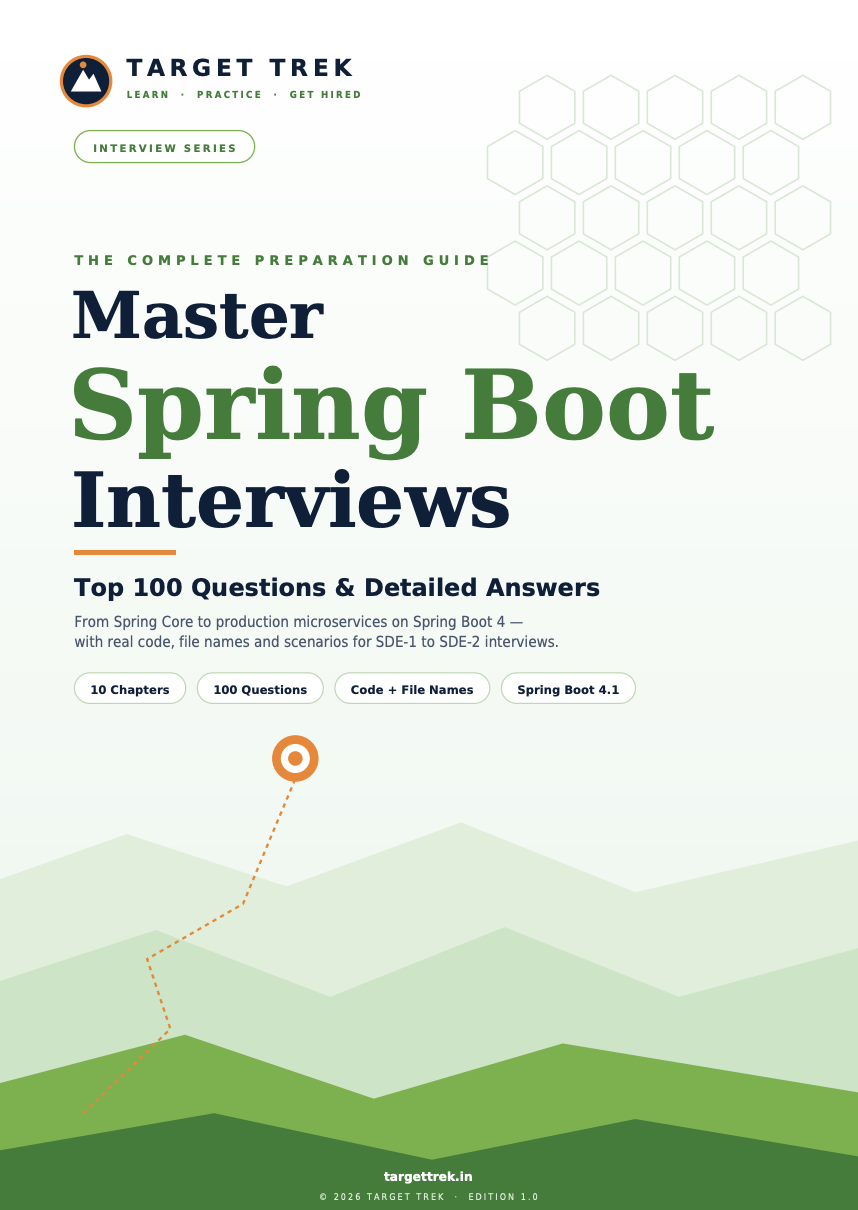
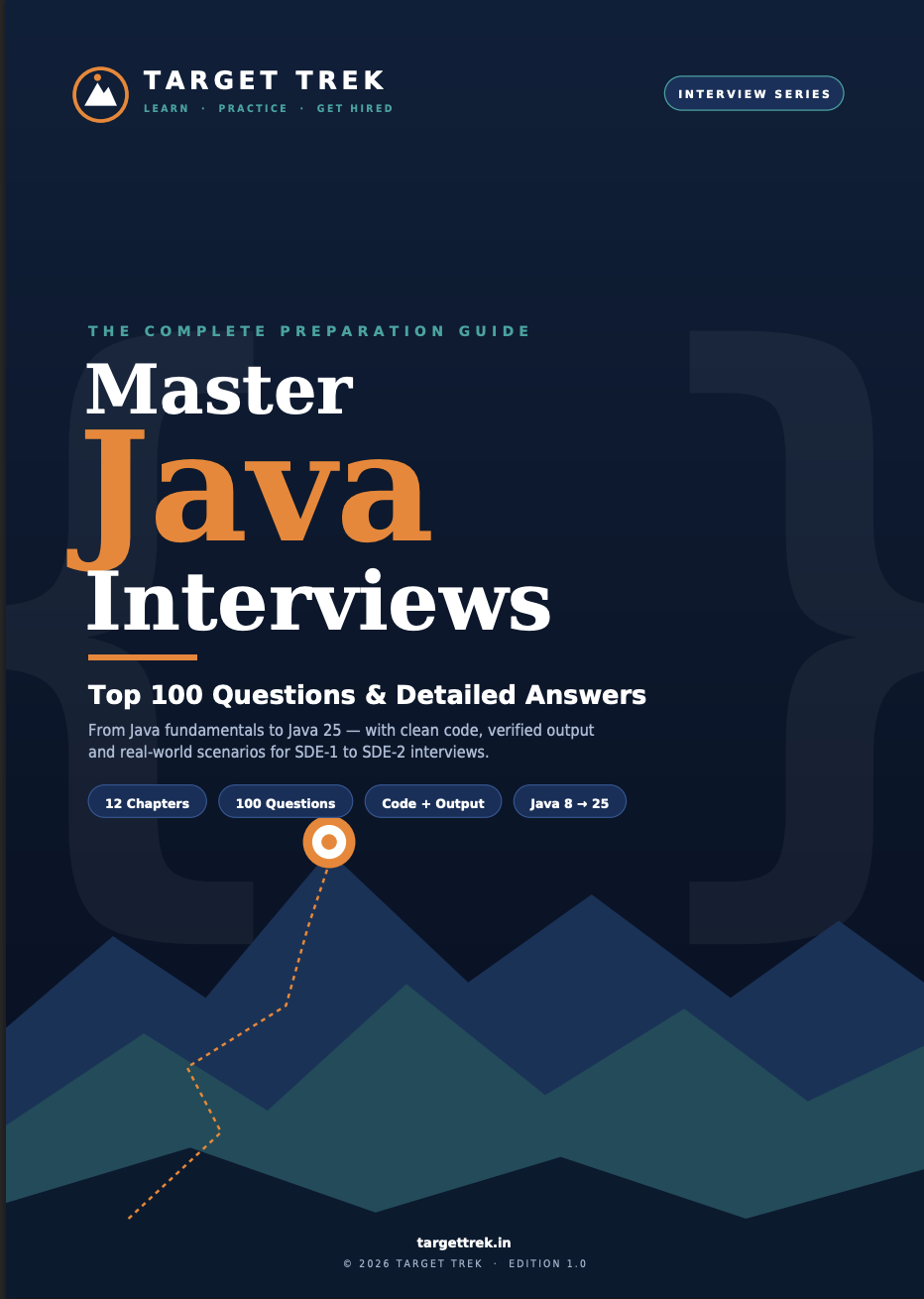
Master Springboot Interview
IoC and DI, REST APIs, Spring Data JPA, transactions and AOP, Security with JWT, microservices, Redis, Kafka and real scenarios.
- 100 questions in 10 chapters
- Java and Spring code examples
- 10 SDE-2 backend scenarios
100 questions from IoC and auto-configuration to JPA, transactions, Spring Security with JWT, microservices, Redis and Kafka, ending with 10 real SDE-2 production scenarios.
PDF ebookThe Spring Boot Interview Handbook is a digital PDF ebook by Target Trek with 100 Spring Boot interview questions and answers in 10 chapters, covering Spring Core and dependency injection, REST APIs, Spring Data JPA, transactions, Spring Security with JWT, microservices, Redis and Kafka. It ends with 10 real-world backend scenarios of the kind asked in SDE-2 interviews.
Interviewers ask what @Transactional does, then why it did not roll back. This book prepares you for the second question.
Without a plan: Memorising annotations without knowing how they work
With this handbook: Internals explained: proxies, bean lifecycle and auto-configuration
Without a plan: Knowing CRUD but freezing on transaction and locking questions
With this handbook: JPA, transactions and concurrency covered with code
Without a plan: Theory-only answers when asked what happens if production breaks
With this handbook: A full chapter of real-world SDE-2 backend scenarios
Without a plan: Scattered notes across blogs and videos
With this handbook: 100 questions, 10 chapters, one revision plan
Go beyond definitions and learn how Spring Boot components actually work underneath.
Annotations, configuration and real implementation patterns, shown in short runnable snippets.
A concise answer for each question, plus the deeper concept behind the likely follow-up.
Connect every concept to REST APIs, databases, security, concurrency and production systems.
Climb from fundamentals to internals, architecture and troubleshooting scenarios.
Questions grouped by topic, chapter summaries and a 7-day plan for the week before.
Core Java is the first round, Spring Boot is the backend round and LLD is the design round. Each book stands alone, and together they cover a full Java SDE interview loop.

IoC and DI, REST APIs, Spring Data JPA, transactions and AOP, Security with JWT, microservices, Redis, Kafka and real scenarios.

Core Java, OOP, Strings, Collections and HashMap internals, Streams, multithreading, JVM and modern Java 17 / 21.

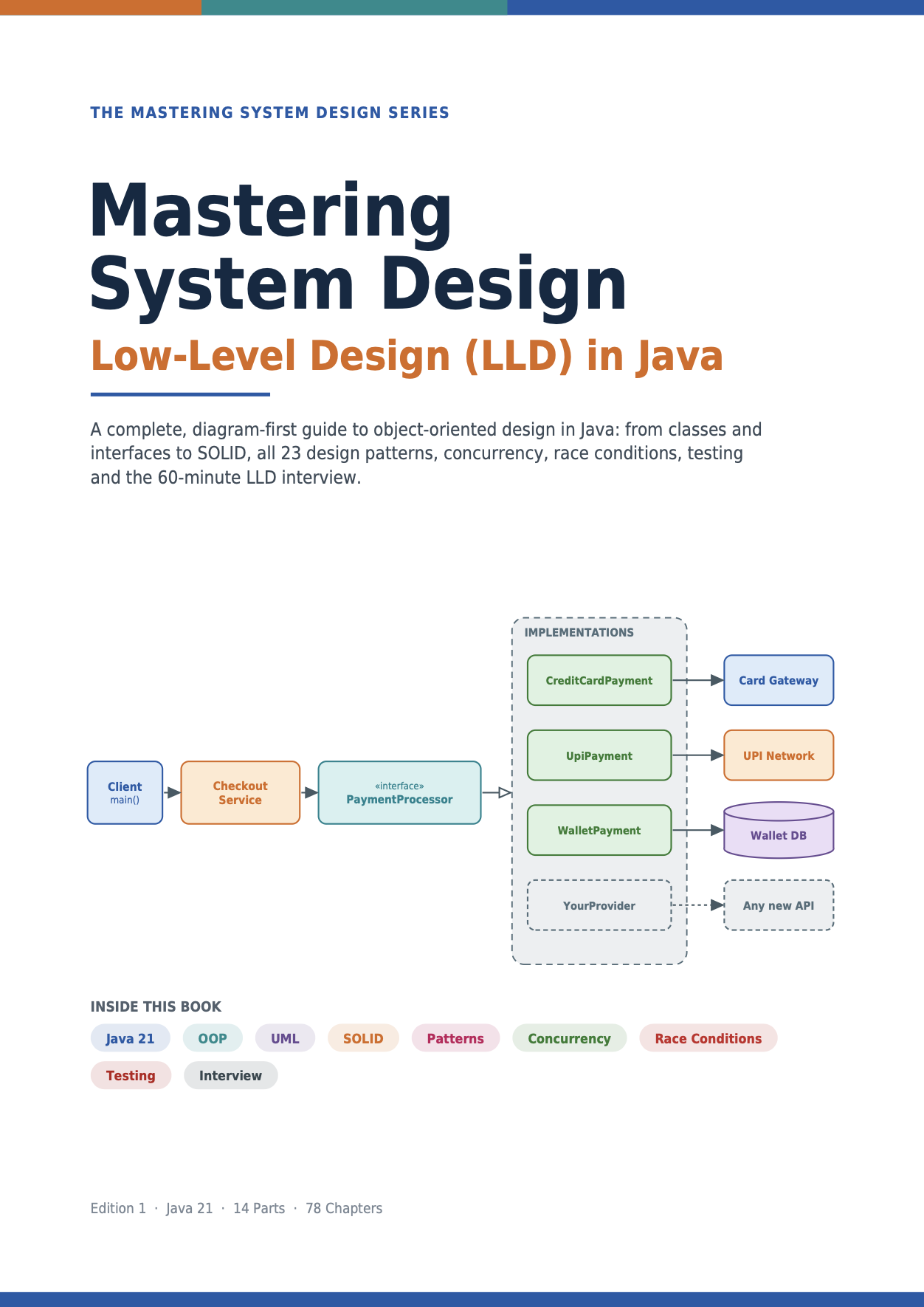
Turn requirements into clean object models, apply SOLID and design patterns, and practise complete Java LLD problems.
This is the full list. Filter by level, search for a topic such as JWT or N+1, and open any chapter to see every question in it.
100 of 100 questions
What Spring Boot adds on top of Spring: auto-configuration, starters, startup, embedded servers and configuration.
The container itself: inversion of control, injection styles, beans, scopes and the bean lifecycle.
Building clean APIs: controllers, mappings, DTOs, validation, global error handling and pagination.
Database access done right: repositories, mappings, fetching, the N+1 problem, locking and migrations.
What happens behind the annotations: proxies, propagation, isolation, AOP and circular dependencies.
Authentication and secure APIs: the filter chain, JWT, OAuth2 and OIDC, RBAC, CORS, CSRF and passwords.
Services that talk to each other and survive failure: clients, discovery, gateways, resilience and sagas.
Real-world integrations: caching, cache invalidation, Kafka producers and consumers, async and scheduled jobs.
Production readiness: test slices, Testcontainers, tuning slow APIs, WebFlux, Actuator and observability.
Think like an SDE-2: reason through concurrency, payments, latency, scale and deployment problems out loud.
The way every answer is written: a direct reply you can say in the interview, the detail behind it, and the follow-up to expect.
It is a shortcut for three annotations. @SpringBootConfiguration marks the class as a source of bean definitions, @EnableAutoConfiguration loads the auto-configuration classes whose conditions match your classpath and properties, and @ComponentScan picks up your @Component, @Service, @Repository and @Controller classes from that package downwards.
Likely follow-up: How would you exclude one auto-configuration class, and why might you need to?
Most Spring questions are about one of these five steps. The book takes each one apart.
The JWT is validated and the SecurityContext is set before any controller runs.
Finds the matching @RequestMapping handler and converts the JSON body into your DTO.
Validates input and delegates. Failures go to your @RestControllerAdvice.
A proxy opens the transaction, calls your method, then commits or rolls back.
Spring Data builds the query; Hibernate tracks entities and flushes on commit.
The kind of short checks interviewers use to test real understanding. Pick an answer to see the explanation.
Patterns from the book that come up in almost every backend interview.
Spring-managed dependencies, final fields and a service you can unit test without starting Spring. Chapter 02 explains why interviewers care.
@Service
public class BookService {
private final BookRepository repository;
public BookService(BookRepository repository) {
this.repository = repository;
}
public List<Book> getBooks() {
return repository.findAll();
}
}Questions with no single right answer. The book shows how to reason through each one and which trade-offs to name.
Two requests try to buy the last item at the same time. How do you prevent overselling?
@Lock(PESSIMISTIC_WRITE) · @VersionThe gateway sends the same webhook twice. How do you make processing idempotent?
unique event id + upsertIs the time going to slow queries, an exhausted thread pool or a downstream call? How do you find out?
Actuator · tracing · slow query logWhat happens when request threads or database connections run out, and how do you protect the app?
HikariCP pool · bulkheadHow should retries, dead-letter topics and duplicate events be handled safely?
retry topic → DLTHow do you roll out new code and database changes while staying available?
rolling · readiness probesOne focused block a day. The question numbers tell you exactly what to read.
Auto-configuration, starters, startup, DI, bean scopes and lifecycle.
Ch 01–02 · Q1–Q20Controllers, mappings, DTOs, validation, global errors, PUT vs PATCH.
Ch 03 · Q21–Q30Relationships, lazy loading, N+1, flush, JPQL and locking.
Ch 04 · Q31–Q40Proxies, propagation, isolation, self-invocation and CGLIB.
Ch 05 · Q41–Q50Filter chain, JWT, OAuth2, gateways, circuit breakers and sagas.
Ch 06–07 · Q51–Q70Caching, Kafka failures, @Async, test slices, Actuator and tracing.
Ch 08–09 · Q71–Q90Work through all 10 production scenarios out loud, then re-read every answer you hesitated on.
Ch 10 · Q91–Q100Build a strong Spring Boot foundation before your first Java backend interview.
Move from Core Java to the Spring Boot round with the internals behind the annotations.
Strengthen your grasp of APIs, databases, security and production systems.
Prepare for theory, internals, implementation and scenario-based rounds.
What you get
Anything else? Write to [email protected]
Yes. It begins with Spring Framework and Spring Boot fundamentals, then moves to database integration, security, microservices and production scenarios. Basic Core Java knowledge is recommended before you start.
Spring and Spring Boot fundamentals, IoC and dependency injection, REST APIs and exception handling, Spring Data JPA and Hibernate, transactions and AOP, Spring Security with JWT and OAuth2, microservices, Redis, Kafka and async processing, testing and monitoring, and real-world backend scenarios.
Yes. Java and Spring Boot examples explain the key annotations, REST controllers, exception handling, JPA queries, transactions and locking, security, caching and other topics.
Yes. The later chapters cover transactions, concurrency, Spring internals, microservices, Kafka, Redis, observability, and a full chapter of scenario questions such as overselling, duplicate webhooks, slow APIs and zero-downtime deployment.
HLD focuses on distributed architecture and scalability, and LLD on object-oriented class design. This handbook focuses on Spring Boot and Java backend interview questions. The LLD (Java) book is a good next step after it.
Yes. The Java Interview Handbook has 100 Core Java questions on OOP, Collections, Streams, concurrency, the JVM and modern Java. Both books are shown in the series section on this page.
No. It is built for technical interviews and revision. It explains concepts in depth, but it does not replace a full project-based development course.
It is a digital PDF ebook. After your payment is confirmed you get access through Target Trek's ebook delivery flow, and you can read it on any phone, tablet or laptop.
Digital purchases are non-refundable. For payment or access help, email [email protected].
100 questions, 10 chapters, real Spring code and 10 production scenarios, in one PDF you can read anywhere.